Category Archives: gardens with wildlife

living around wildlife

Orange Candleflower

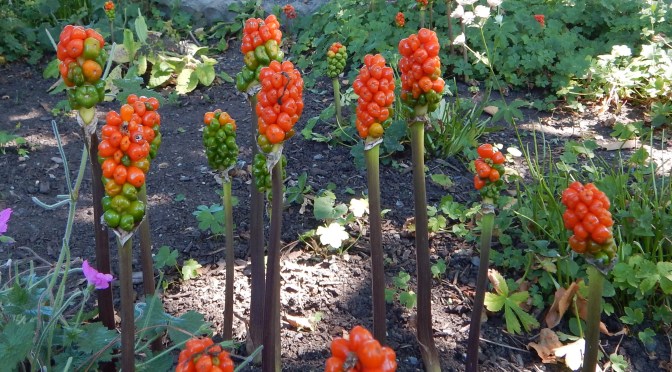
I’ve admired the fall show of Orange Candleflower for ages. I first saw the funky, candle-like seed spikes beside the front gate at Abkhazi garden. Later, KL & I admired swaths of them in a woodland at Government House garden.

Arum Italicum, orange candleflower, lords and ladies, cuckoo's pint, Italian lily, Italian arum, garden Victoria BC Pacific Northwest
photo by SVSeekins

Arum italicum leaves die back in the summer leaving a naked stem & seed head. Groovy, eh? Perhaps that’s why it’s sometimes called Lords & Ladies. The Lady is the shy, white, spring flower. The Lord is the seed head. His Lordship might be inconspicuous early on, but as he matures from green to bright red… he’s certainly aristocratic.
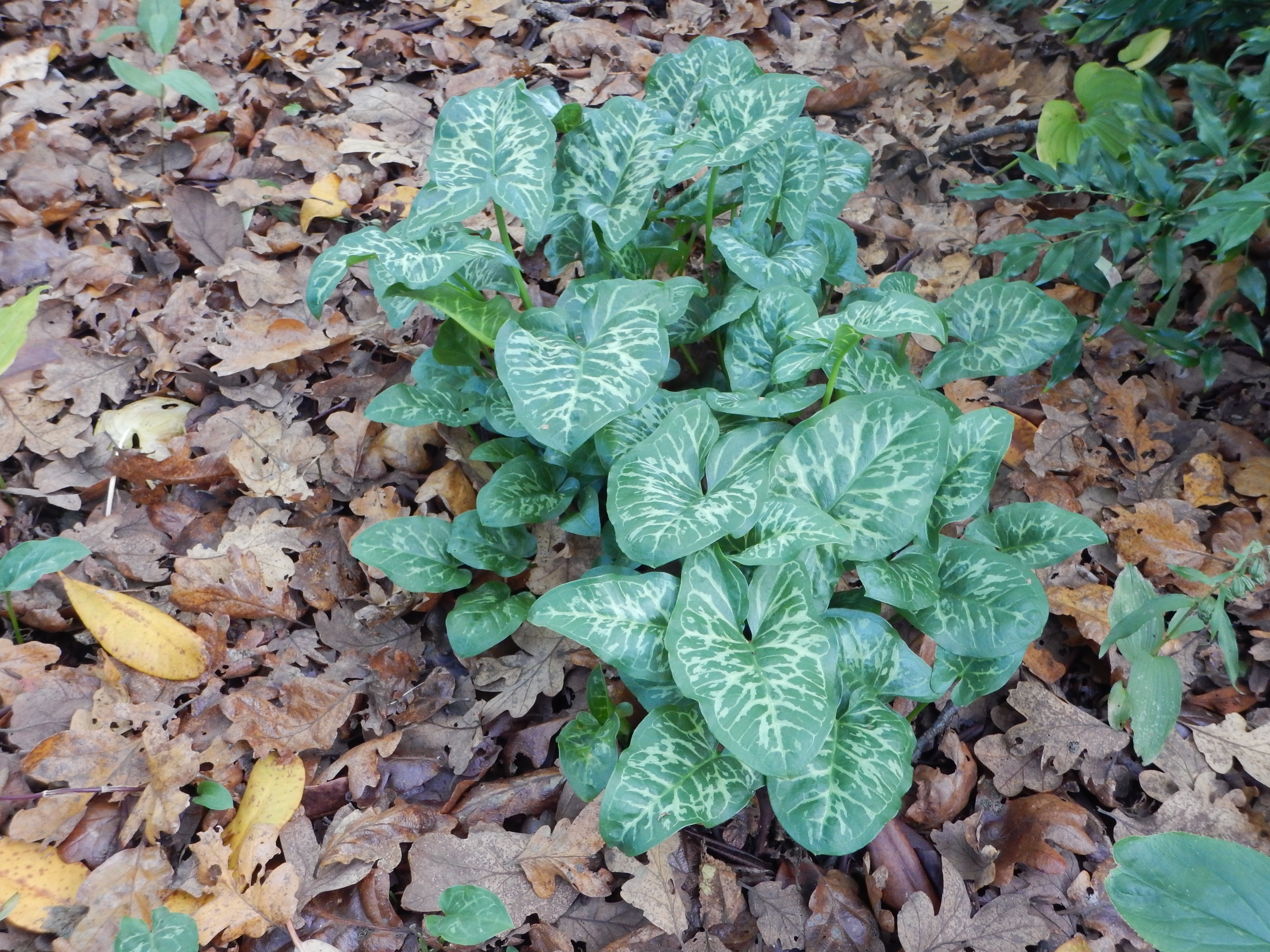
Arum Italicum, orange candleflower, lords and ladies, cuckoo's pint, Italian lily, Italian arum, garden Victoria BC Pacific Northwest
photo by SVSeekins

Over the years I’ve sourced Italian arum through the garden club. I carefully planted several small pots around our garden.
No joy.
The winter ephemeral leaves delight me from late autumn, right through winter & even spring…
but never flowers. 😦

Blooms are supposed to appear in May – but there’s SO MUCH going on then…. maybe I just missed them? Can I blame the deer? Word has it that Arum Lily, & all its parts, is poisonous to people & animals so my deer excuse doesn’t really fly.
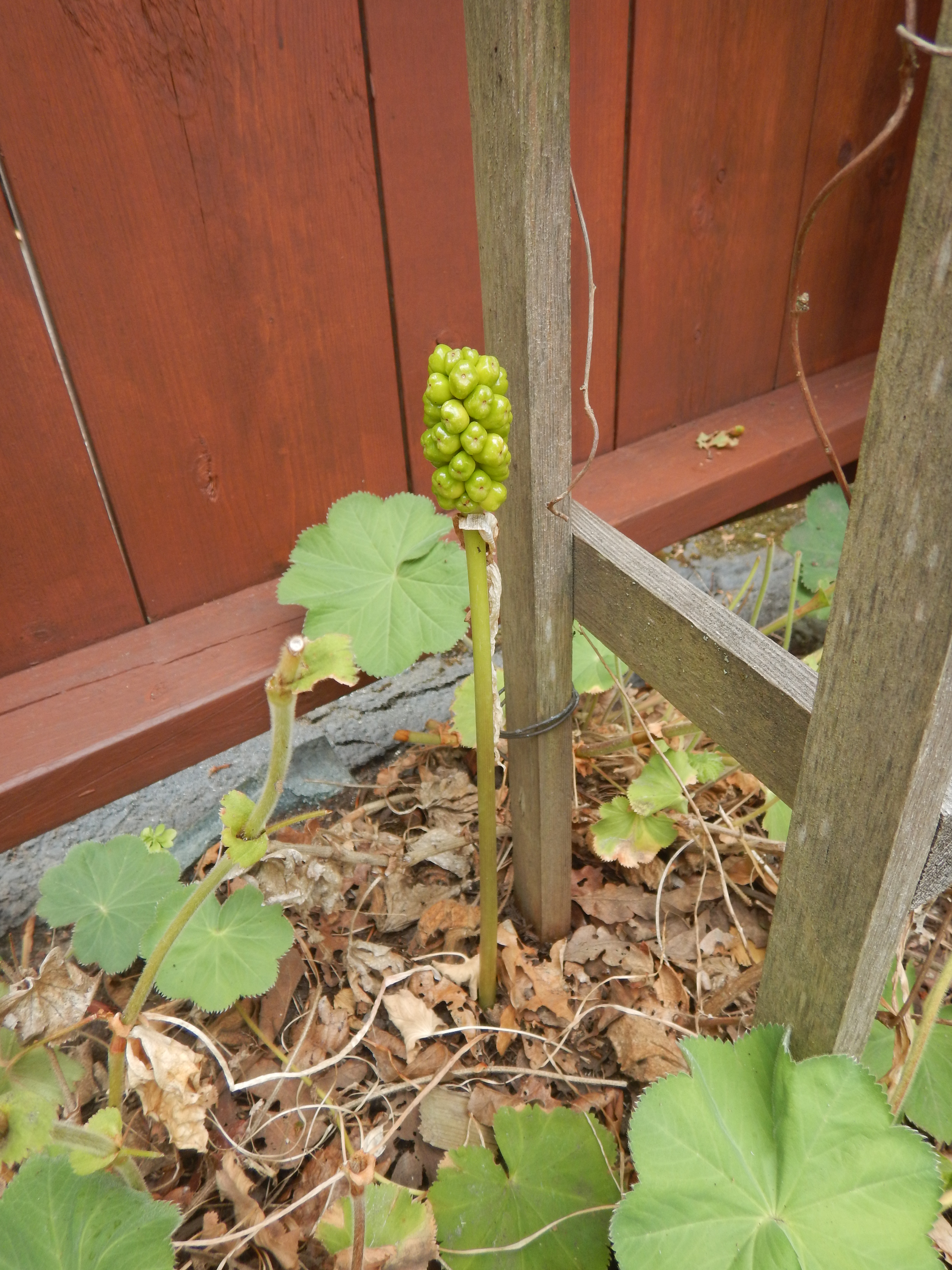
Arum Italicum, orange candleflower, lords and ladies, cuckoo's pint, Italian lily, Italian arum, garden Victoria BC Pacific Northwest
photo by SVSeekins

This August I was delighted to spy a stem with berries maturing in a shady spot beside our garden gate. Hooray! Don’t believe me? Take a look…. way down…. one lonely stem… It’s really there!

Arum Italicum, orange candleflower, lords and ladies, cuckoo's pint, Italian lily, Italian arum, garden Victoria BC Pacific Northwest
photo by SVSeekins

I crossed my fingers hoping it would soon turn the vibrant red it’s famous for. It took some time but by October it glowed!

Arum italicum is a Mediterranean perennial that’s naturalized across Britain, Europe and even parts of Australia. It’s apparently causing enough nuisance in Oregon & Washington to be listed as invasive!

Arum Italicum, orange candleflower, lords and ladies, cuckoo's pint, Italian lily, Italian arum, garden Victoria BC Pacific Northwest
photo by SVSeekins

And here I am, excited about a single phallic seed stalk. It’s certainly not conquering anything in our garden.

Consulting several sources reveals these nobles cause revolts in moist environments. That’s probably why I have so little success with it – – I only drag around a water hose when it’s really needed.

I dream of seeing the Lady’s flower. Now my plan is to shift some into more favourable conditions – perhaps the hosta patch? When the hostas die back in the fall, the arum leaf will come alive.
Fingers crossed.

-30-
Rutting Season

There is a distinct odour in the air. Not a pleasant one. It reminds me of the smell of a billy goat – – I remember that bouquet (?) from the farm. We kept dairy goats, mostly nannies. Of course, every herd needs a billy.

ws Deer Antlers vs fencing 1
photo by SVSeekins

Our billy (like any billy goat) always emitted an odd scent, but in rutting season it became particularly stinky.
Deer are like that, too.

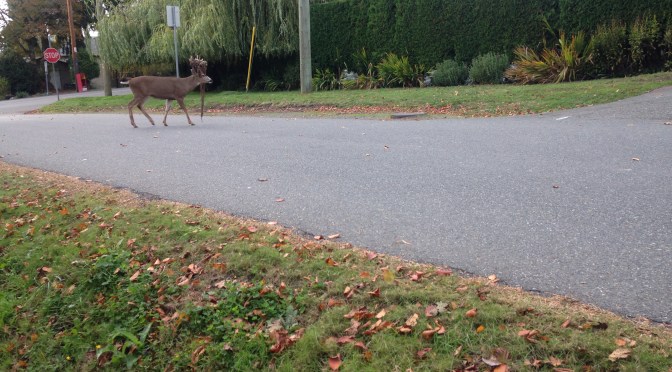
Today C spots the buck first. The male deer is just exiting the gate at the far end of our garden. I’m not surprised to see him – we could smell him coming. ‘Tis the season.

What does surprise me is his unusual outfit. His antlers are festooned with… something?
It’s hard to tell what…

I pull out the cell phone & carefully try to get closer. Deer–especially bucks– are uppity at this time of year. Sometimes it’s just safer to zoom into a photo after the fact… so here’s a closer look at the same photo:

cu Deer Antlers vs fencing 1
photo by SVSeekins

Crazy, eh? It’s a bit blurry, but it looks like a shovel handle (with no shovel) is hooked over one of his horns!

ms Deer Antlers vs fencing 3
photo by SVSeekins

As he heads across the street, he gets a little closer. It’s still really hard to tell what this mess is all about.

The shovel handle swings from his antlers as he walks. That must feel so awkward… but he isn’t limping or having trouble holding up his head. Why doesn’t he just lower + shake his head until the handle slips off?

ws Deer Antlers vs fencing 2
photo by SVSeekins

He sees me watching, but he doesn’t seem bothered by me – bucks are often cocky that way. I daren’t face him directly – he’d interpret that as a challenge.

I’ll bet he has a headache, but he doesn’t seem fighting mad or even ornery… so, in hopes of getting a better view, I follow him.

He strolls into Friendly Neighbour’s yard & heads to the quiet corner the local herd prefers. I don’t see anything much as he walks away, but finally, he turns a bit to the side.

What is all that extra stuff obscuring his antlers? It doesn’t look like hedge trimmings – which is C’s guess. Bucks are notorious for thrashing antlers along tree trunks and through shrubs.

ws Deer Antlers vs fencing 2
photo by SVSeekins

My best guess is someone installed deer netting along their hedge this spring & the new growth obscured the fine mesh. Perhaps this fellow tried to walk through & was caught up in it? The tangle has trapped the shovel handle where it hangs…

Or maybe that mesh was protecting a tasty vegetable patch that he just couldn’t resist? I’m so curious… What’s your guess?
How did he get so tangled?
& How will he ever free himself from it?

-30-

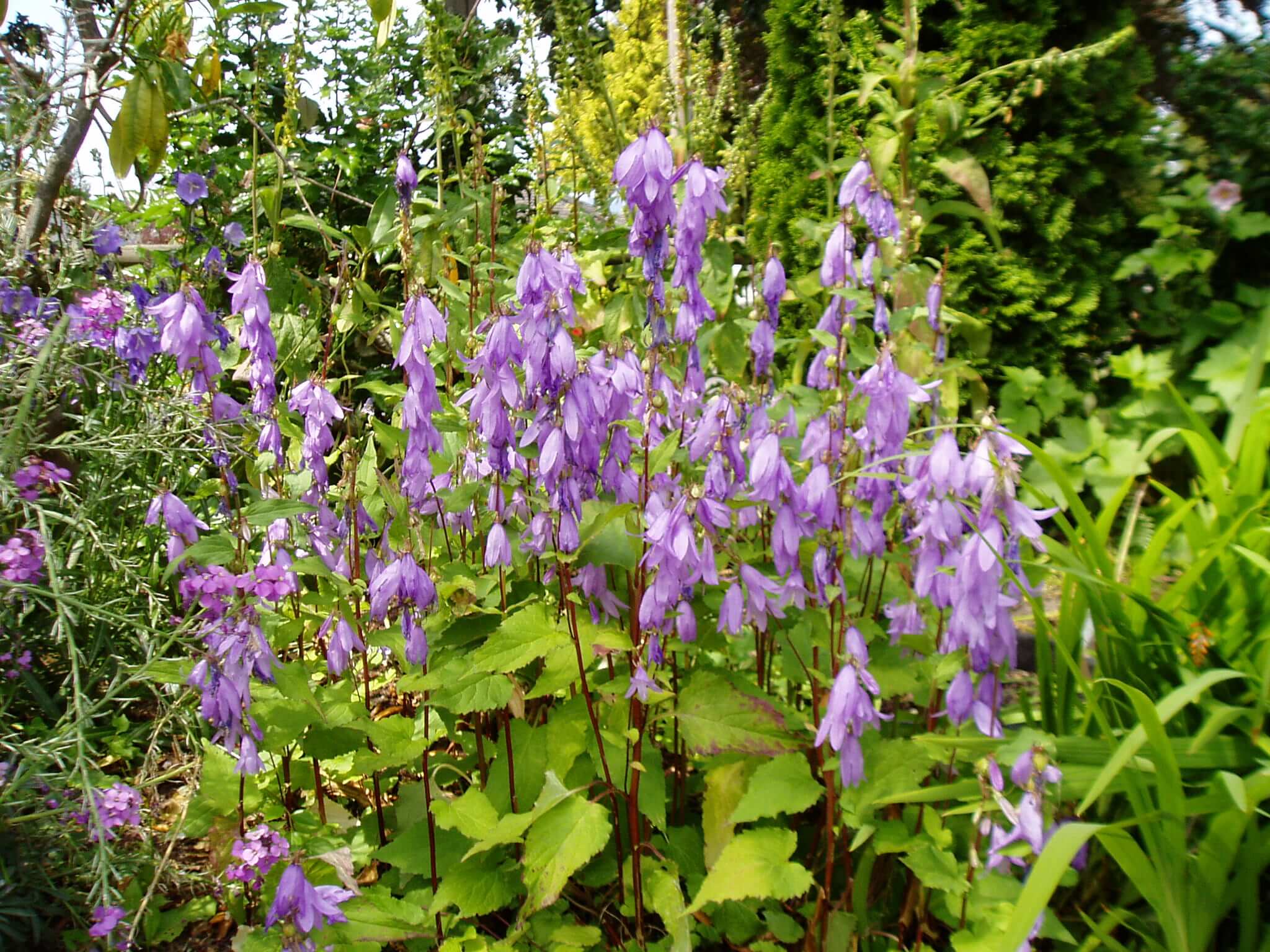
Creeping Bellflower – Campanula rapunculoides

It came into our garden with some ‘free’ soil.  I didn’t know its name, for sure.  It looked an awful lot like ladybells, Adenophora liliifolia?  It was a decorative, bonus plant – score!
Little did I know the work that pretty bellflower would create.

Campanula rapunculoides, creeping bellflower, Bluebell weed, rampion bellflower, rover bellflower, European bellflower, garden Victoria BC Pacific Northwest
photo by SVSeekins

Deer ignored it for one season… at the most. After that, they ate the buds before flowering. The deers’ pruning might’ve spurred the plant into a frenzy of suckering.  When digging out the extras, I realized how this bellflower got its common name– Creeping Bellflower spreads from the mother plant by lateral roots running below the soil surface.

It quickly became quite a thug.  I had to be realistic. A monocultural garden isn’t my thing.  Campanula rapunculoides had to go.

Campanula rapunculoides, creeping bellflower, Bluebell weed, rampion bellflower, rover bellflower, European bellflower, garden Victoria BC Pacific Northwest
photo by SVSeekins

One soggy autumn weekend, I dug out the entire bed.  Other keeper perennials were set aside to thoroughly wash their root systems before replanting at the end of the project.  I discovered creeping bellflower was even more invasive than I first realized.  It also has deeper storage roots, enabling survival through brutal winters & long droughts. Those roots can easily sprout a multitude of new plants, even if the original is removed from the base.
Tenacious.

Sifting through the soil & removing the invading white roots of the C.rapunculoides, was a tough job but worth it.  Many years later, I regularly weed out young plants surfacing from roots that I’d missed, but I’m winning the war.

Campanula rapunculoides, creeping bellflower, Bluebell weed, rampion bellflower, rover bellflower, European bellflower, garden Victoria BC Pacific Northwest
photo by SVSeekins

This summer, I noticed a new patch at the College campus. Can you imagine the tenacity of a plant volunteering in a crack in the pavement?  These plants must’ve arrived via seed distribution. Behind some fencing, creeping bellflower is protected from the deer. Fortunately, the grounds staff cut them to the ground in record time.

Campanula rapunculoides, creeping bellflower, Bluebell weed, rampion bellflower, rover bellflower, European bellflower, garden Victoria BC Pacific Northwest
photo by SVSeekins

So, I guess it’s not even safe to keep this bully restrained in a pot because it’ll spread like mad if it ever goes to seed, too.

I’m pretty lenient when it comes to vigorous plants in our garden..  Wild violets grow in our lawn. Cyclamen hederifolium is still welcome in certain beds. I’ve left some patches of bluebell in well-contained spots (but they’re sheered as soon as the blooms begin to fade).  Some other tough-as-nails plants are held in check by simply not watering them through our long, summer drought.

But I’m putting my foot down when it comes to Campanula rapunculoides.
Not in my backyard.
My goal is to grow the native harebell, C. rotundifolia, instead. It’s much better behaved.

-30-