Tag Archives: native plants

Landscaping With Wild Strawberries

An early summer adventure when I was a kid, was picking tiny, wild strawberries.  They were packed with incredible flavour.  We would forage for ages just to bring home a small bowl full, but it was always worth it.

wild strawberries 1
photo by SVSeekins

More recently (2 years ago), at a ‘Gardening with Native Plants’ workshop, I learned those very same plants will happily grow in the urban landscape.  How cool is that?  Plants that provide an opportunity to forage in my own yard AND do double duty as a ground cover! Bring it on!

I’d never seen thick mats of strawberries like those in the photos at the gardening workshop, but Pat Johnston really knows her stuff, so I totally believed it was possible.  I immediately formed a plan.

Trent Street garden
photo by SVSeekins

Pat explained the 2 kinds of local wild strawberries to take into consideration.  The coastal strawberry is a tough, full sun, drought tolerant workhorse.  The woodland strawberry also works great as a ground cover, but performs much better in more shady parts of the garden.

After running across a bed of wild strawberries growing prolifically in a curbside city garden – – and looking like they were about to take over the sidewalk, I was even more encouraged. Who knew wild strawberries would grow so well in town? I set about planting coastal strawberries in our sunny garden bed.

The landscape trend was spreading.  A new native landscape area at the college down the street was planted with wild strawberries, too.

strawberry patch at Camosun's Lansdowne campus
photo by SVSeekins

The other day (2 years later) I walked by the spot and was impressed by how well that area had filled in.  Perhaps the Camosun groundskeepers fertilize a little more than I do?… or maybe they water the area more?  or maybe they originally planted more starts?… I’m not sure.  But it looks great, doesn’t it?.

I reckon our strawberry patch will catch up in another year or two.  In the meantime I’m enjoying watching my own little community of strawberries send out their ‘runner babies’.

The birds are more vigilant than I am, so I don’t expect to ever have enough harvest to make jam or pie.  I figure the occasional berry is a reward for getting out in the garden to water or weed.

-30-
© SVSeekins and Garden Variety Life, 2013

strawberry patch at Camosun'
photo by SVSeekins

Meadow Blooms 5 – Camas

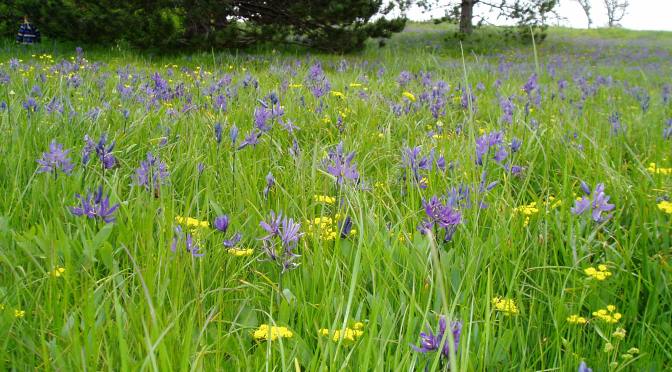
The camas meadow swaying in the spring breeze is like no other.  Suddenly I’m walking in a fairytale instead of strolling in a Victoria park.  Has my mind gone wild?  Could I ever have come up with a dream so lovely?  No.  It must be real.

No gardener created this scene, either.  This is Nature’s beauty.

Camas Meadow - Beacon Hill Park 3
photo by SVSeekins
camas at Mt. Tolmie Park 2
photo by SVSeekins

Camas meadows have flourished on South Vancouver Island longer than memory reaches into the past.  The southern slope of Beacon Hill has been a camas meadow for centuries.  It’s probably one of the key reasons it’s preserved as a park today.  The same goes for the Garry oak meadows of Mt. Tolmie Park.  At this time of year, they’re magical places.

Early peoples saw more than beauty in the camas; they saw food.  I wonder who it was to first realize the bulbs are delicious?

Camas at Mt. Tolmie Park 1
photo by SVSeekins

Perhaps she had gardening tendencies like mine; seeing a lovely flower automatically triggers an urge to have that flower in my own garden.  (I’m known to dig up plants from roadsides.)

Before we moved from the Cedar Hill property to the Richmond house, I dug up as many camas as possible.  The Garry oak meadow in the backyard was a great natural source for them, but the digging wasn’t so easy.

When I was able to dig deep enough, I often found the bulb tucked securely in a tight rocky crevice.  Un-obtainable! I did manage to get a good number of bulbs (perhaps 2 dozen), but there was no risk of over-harvesting that hillside.

camas blooms cu
photo by SVSeekins

There was certainly more risk of starvation if camas had been my only sustenance.   A good deal of effort for a very small reward.  That gardener from long ago must’ve had more ingenuity than I have.

Apparently, she figured out a method that includes burning the meadow first. (?!?!…)  Perhaps that was a way of cooking the camas in the process? By the time she got one out of the ground, it was already transformed into a sweet treat?  I just can’t figure it….

Happily, after all my sweat equity, I now enjoy blooming borders.

  • snowdrops in January… 
  • crocus in February… 
  • daffodils in March… 
  • hyacinth in April… 
  • and camas in May… 

It times out nicely.  When the foliage of the spring bulb dies back, the daylily takes over for the summer.  And from all that bounty, it’s only the latter that the deer like to feast on.  🙂

a bit of history on camas
a camas recipe
growing camas

-30-
© SVSeekins and Garden Variety Life, 2013
Camas Meadow - Beacon Hill Park 1
photo by SVSeekins

James Bay Rain Garden

Once upon a time (way back in the 90’s) I went to the park on the corner of Superior and St. Lawrence streets to enjoy a game of softball.  The sun was shining, the game was fun, but the temperature was several degrees below the rest of town.  Despite the gorgeous site at Fisherman’s Wharf, it was one of my least favourite parks to hang out in.

new life for the park at Fisherman's Wharf
photo by SVSeekins

Recently this park has climbed up several notches in my esteem.  The city of Victoria has completed a massive makeover.

rolling hills & wandering trails circle the rain garden
photo by SVSeekins

Now it’s a leap to imagine the flat sports field.  Brand spanking new hills block views of the urban streets & buildings.  The varied landscape creates a feeling of privacy.  It makes the green space seem larger than it really is.

Wandering pathways lead to several garden rooms.  I especially like with the emphasis on native plants & trees.  A walk along one of the trails feels so much more peaceful than one on the sidewalk just a few yards away.

excess water will flood into the storm drain (far left)
photo by SVSeekins

Part of the new design is a rain garden.  By coincidence  the same folks that created the Atrium rain garden that I like so much, also came up with this design.

The James Bay project has a much larger retention pond than the little boulevards at Yates and Blanchard streets.

It’s engineered so that the local streets & parking areas provide the runoff water for the large rain garden.  Notice how deep the pond can get before excess water flows into the raised storm drain.  I’m so curious to come back to see the ponds in the peak of rainy season.

in homage to the shoreline & sandy beach of years ago
photo by SVSeekins

A stone wall winds around the park, showing where the natural shoreline used to be.  In one place, The Victoria Parks Department has even gone to the length of adding sand, grasses and logs reminiscent of the past beach.  Isn’t it charming?

the playground near Fisherman's Wharf
photo by SVSeekins

Being near all the boats at Fisherman’s Wharf, it seems suitable that the playground matches with a shipwreck at its entry gate

An open grassy areaa looks out at Fishernan's Wharf
photo by SVSeekins

And for folks that really do want to throw around a baseball, there still is a wide open grassy area.  My imagination has an active game of Frisbee tag keeping me warm against the cool sea breeze.

-30-
© copyright 2013 SVSeekins