Category Archives: months 04-06: spring

April thru June

Cyclamen Seedpods

What does Southern Vancouver Island have in common with Turkey on the Mediterranean?
Hardy Cyclamen.

hardy cyclamen, persian violet, , ivy-leaved cyclamen or sowbread, garden Victoria, Vancouver Island, BC, Pacific Northwest
photo by SVSeekins

Cyclamen hederifolium is native to Turkey,  and that climate is quite like ours.
Would you’ve guessed?
So it kinda makes sense:
What prospers there…
prospers here.

garden Victoria, Vancouver Island, BC, Pacific Northwest
photo by SVSeekins

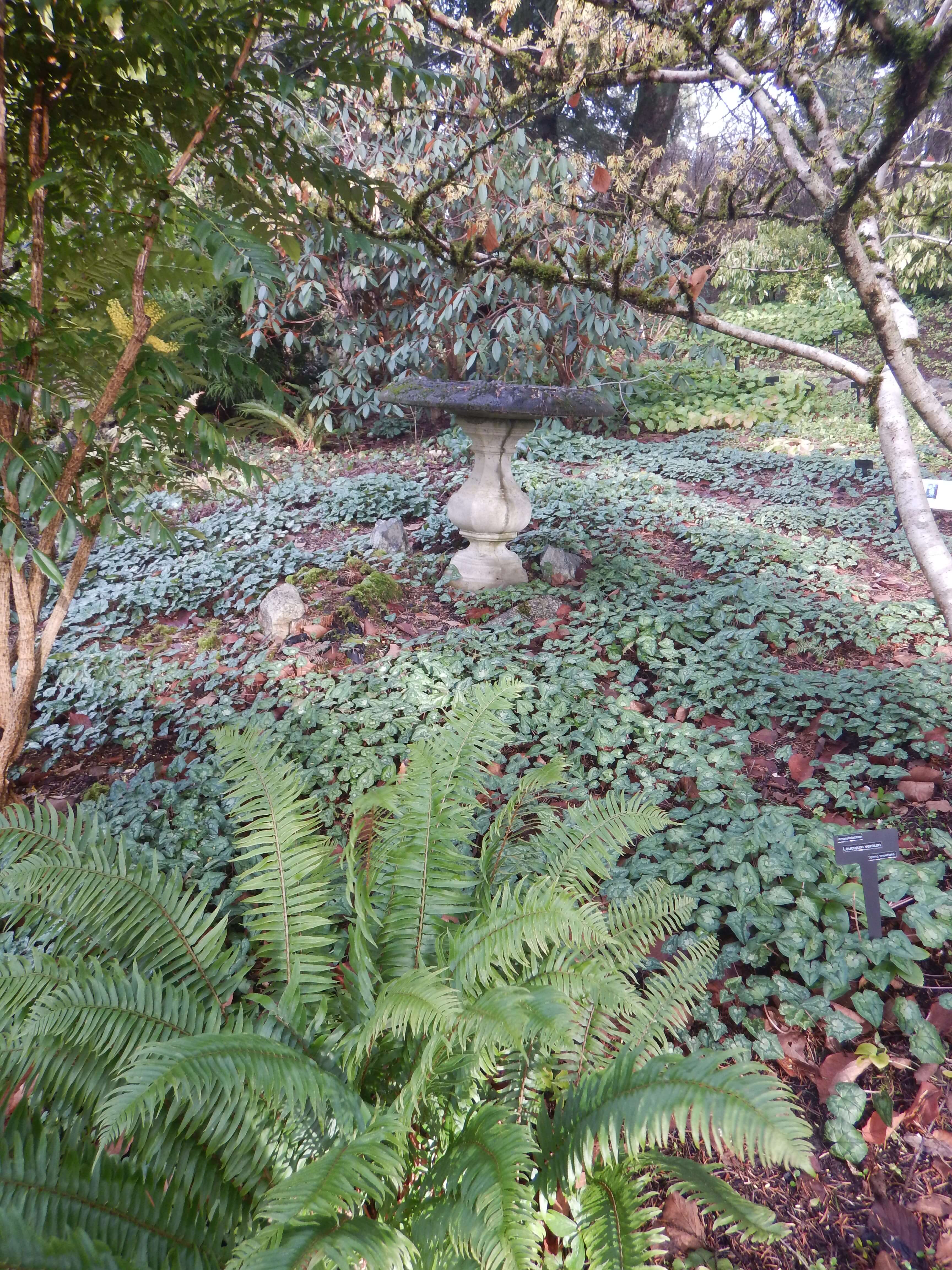
Hardy Cyclamen likes our dry summer.  It goes dormant. Later, the cooling temperatures & returning rain of September triggers the awakening.  One morning flowers are popping out of the ground & dancing in the dappled shade.  What a lovely surprise. Flowers in autumn!
(Plus, what a bonus – a pretty plant that doesn’t need me dragging around a garden hose… AND one that’s happy in those tough-to-garden spots under trees!)

garden Victoria, Vancouver Island, BC, Pacific Northwest
photo by SVSeekins
hardy cyclamen, persian violet, , ivy-leaved cyclamen or sowbread, garden Victoria, Vancouver Island, BC, Pacific Northwest
photo by SVSeekins

After pollinators do their thing, the flower stems curl into tight coils, pulling the seed pods to the ground.  Leaves emerge, protecting the pods from our winter wind & rain.  How tidy is that?   I never feel the urge to deadhead.   (Extra bonus – decorative foliage that stays green through our long, glum winter.  And IF we get snow & severe cold, the cyclamen survives to -28C  a colder winter than we’re likely to get.)

garden Victoria, Vancouver Island, BC, Pacific Northwest
photo by SVSeekins

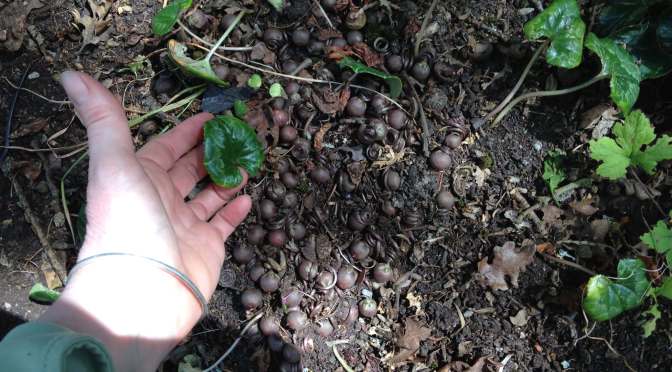
While so much of the garden is going nuts through spring, Cyclamen hederifolium is wrapping up its display. The leaves die back, revealing the maturing seed pods. A matt of balls on coil springs remind me where the plant is preparing for sleep.  Doesn’t it look GROOVY?

hardy cyclamen, persian violet, , ivy-leaved cyclamen or sowbread, garden Victoria, Vancouver Island, BC, Pacific Northwest
photo by SVSeekins

Ants think it’s pretty groovy, too.  The seeds are coated with a sweet film.  Ants gather them & take them home to feed the masses.
Win – Win – Win.
Ants get a treat.
The seed is sown.
And the gardener has a new no-fuss plant.

hardy cyclamen, persian violet, , ivy-leaved cyclamen or sowbread, garden Victoria, Vancouver Island, BC, Pacific Northwest
photo by SVSeekins

What an ingenious system for naturalizing through the garden … and beyond.

Barely noticeable little seedlings sprout in lawns & woodland parks alike.  Eventually, the tiny corms can grow to the size of dinner plates.
Welcome or not.

hardy cyclamen coum, eastern cyclamen C. coum garden Victoria, Vancouver Island, BC, Pacific Northwest
photo by SVSeekins

I grow a few varieties of Hardy Cyclamen. Over 10 years, I’ve noticed a couple baby plants growing near their parents.  I’m particularly fond of the February bloomer Cyclamen coum.

C. coum is a timid seeder in comparison with the C. hederifolium.  The fall bloomer out-competes the winter bloomer.  I’m very careful to keep each cyclamen variety in its own bed.

hardy cyclamen, persian violet, , ivy-leaved cyclamen or sowbread, garden Victoria, Vancouver Island, BC, Pacific Northwest
photo by SVSeekins

Believe it or not — C. hederifolium is on the District of Saanich’s Invasive Plants list!  It naturalizes that well around here.  It must out-compete more than just the C. coum.

I have to admit to still holding a torch for these funky plants.
Does it count in my favour that I’ve dug some cyclamen invaders out of a couple wild parklands?
They’ve been planted in spots they’re not likely to escape without notice…

-30-

Enter your email address to subscribe to this blog and receive notifications of new posts by email.

Digging Bluebells

Hyacinthoides hispanica – bluebells spanish blue bells garden Victoria, Vancouver Island, BC, Pacific Northwest
photo by SVSeekins
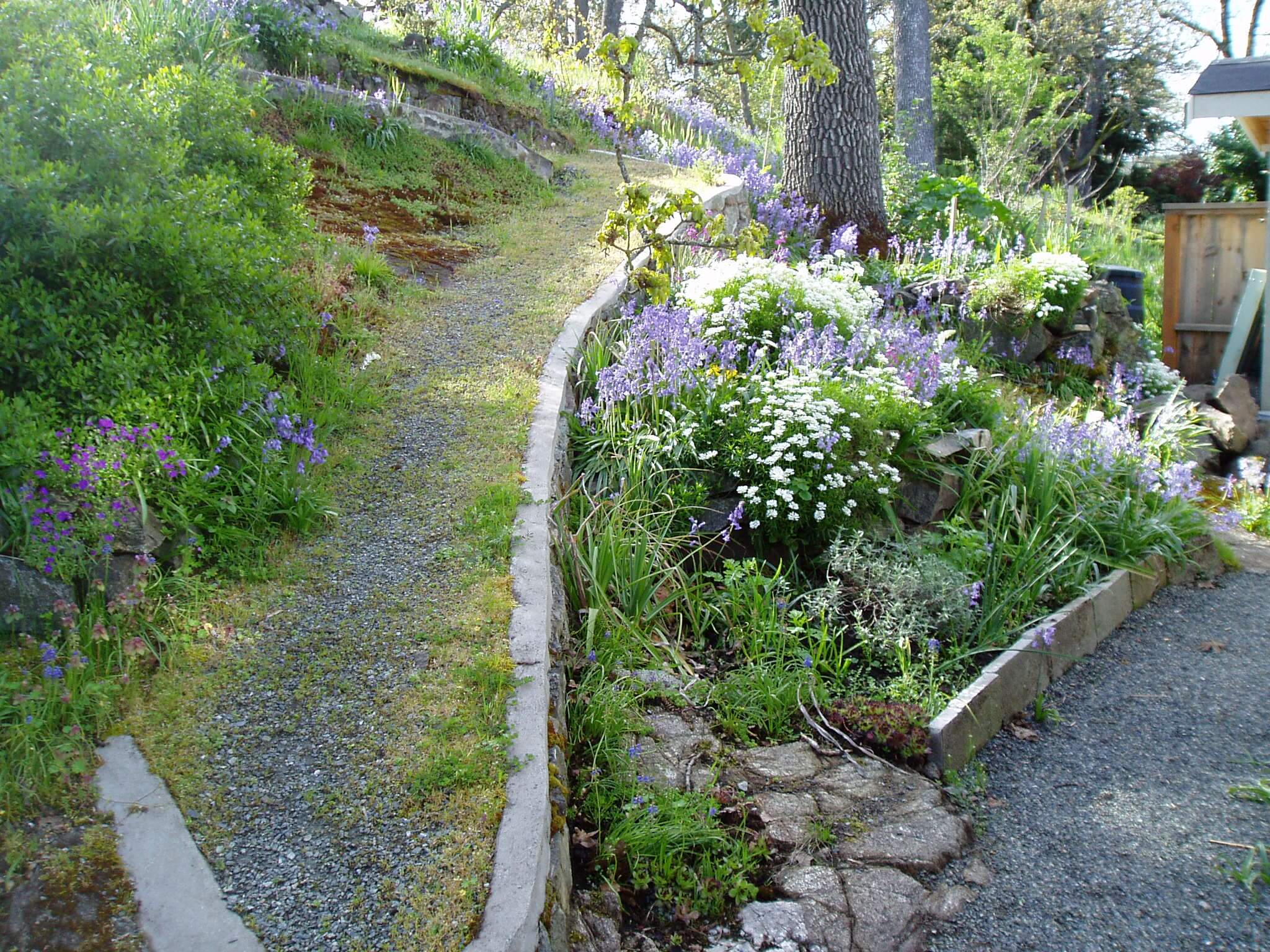
For a few years, I thought bluebells were lovely spring flowers & welcomed them into our beds & borders.  And no wonder:
  • Each stem bears a profusion of bellflowers.
  • The bells dangle & shift delicately in the breeze.
  • Deer ignore the blossoms.
  • Bluebells are just so darn pretty.
  • Great masses of them are even prettier.  Have you seen the blue carpets of English woodlands in bloom?
Hyacinthoides hispanica – bluebells spanish blue bells garden Victoria, Vancouver Island, BC, Pacific Northwest
photo by SVSeekins
In the Pacific Northwest, we have similar growing conditions to the UK. Bluebells grow just as well here but aren’t as welcome.  (preference is for our native Camas.) It’s becoming more apparent to me how thuggish bluebells can be – overwhelming whatever they’re grown with, especially other bulbs – – like Camas.  😦 It’s a pity something so pretty can be such a bully.
before the dig - Hyacinthoides hispanica – bluebells spanish blue bells garden Victoria, Vancouver Island, BC, Pacific Northwest
photo by SVSeekins
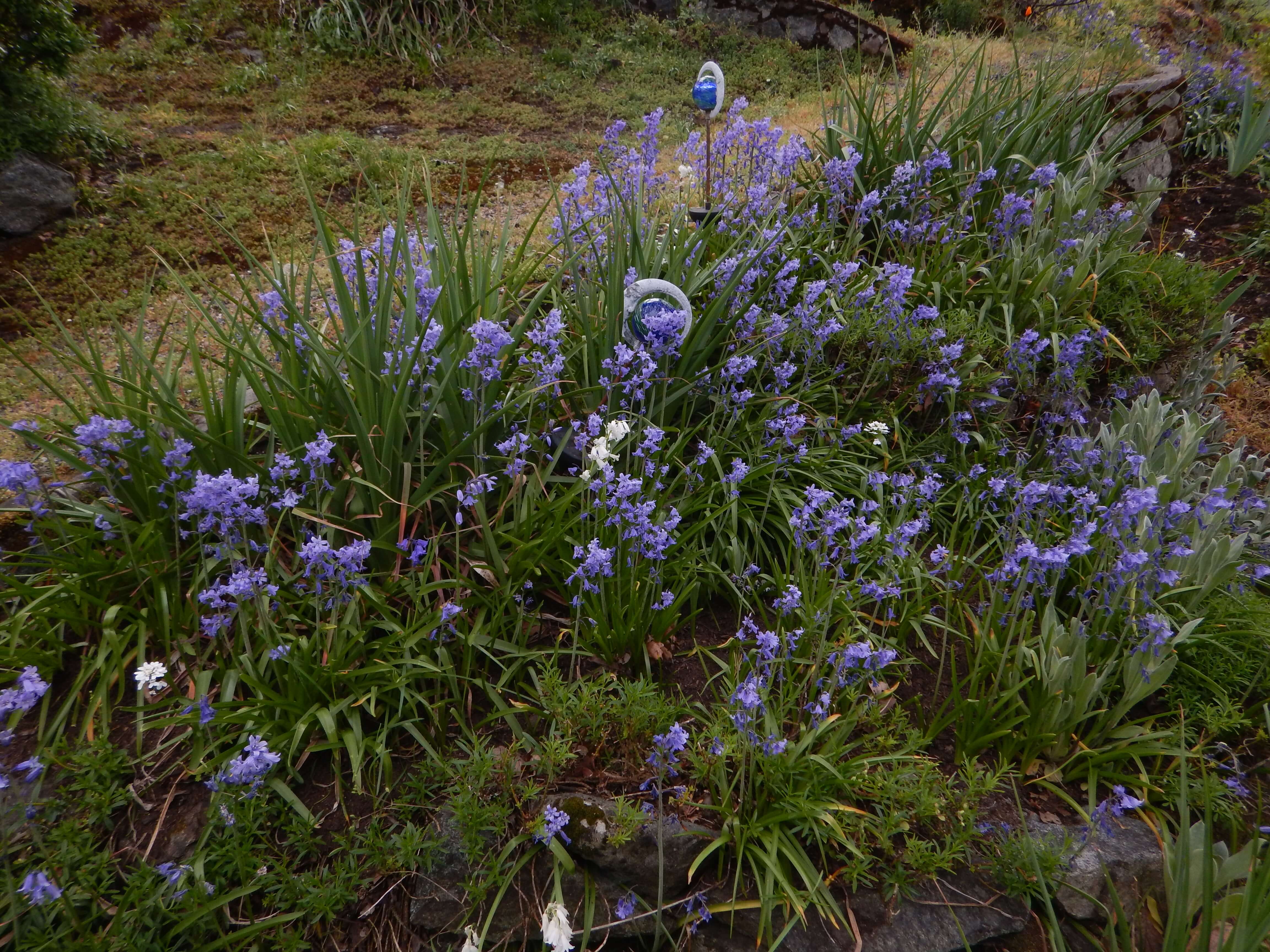
This spring, my challenge is to clear one bed of as much bluebell as possible.  Here’s a “Before the dig” photo: I do like the lush spring foliage of the bluebells, but can you see any of the perennials?  Those plants are hidden from sunshine by masses of bluebell leaf.
Hyacinthoides hispanica – bluebells spanish blue bells garden Victoria, Vancouver Island, BC, Pacific Northwest
photo by SVSeekins
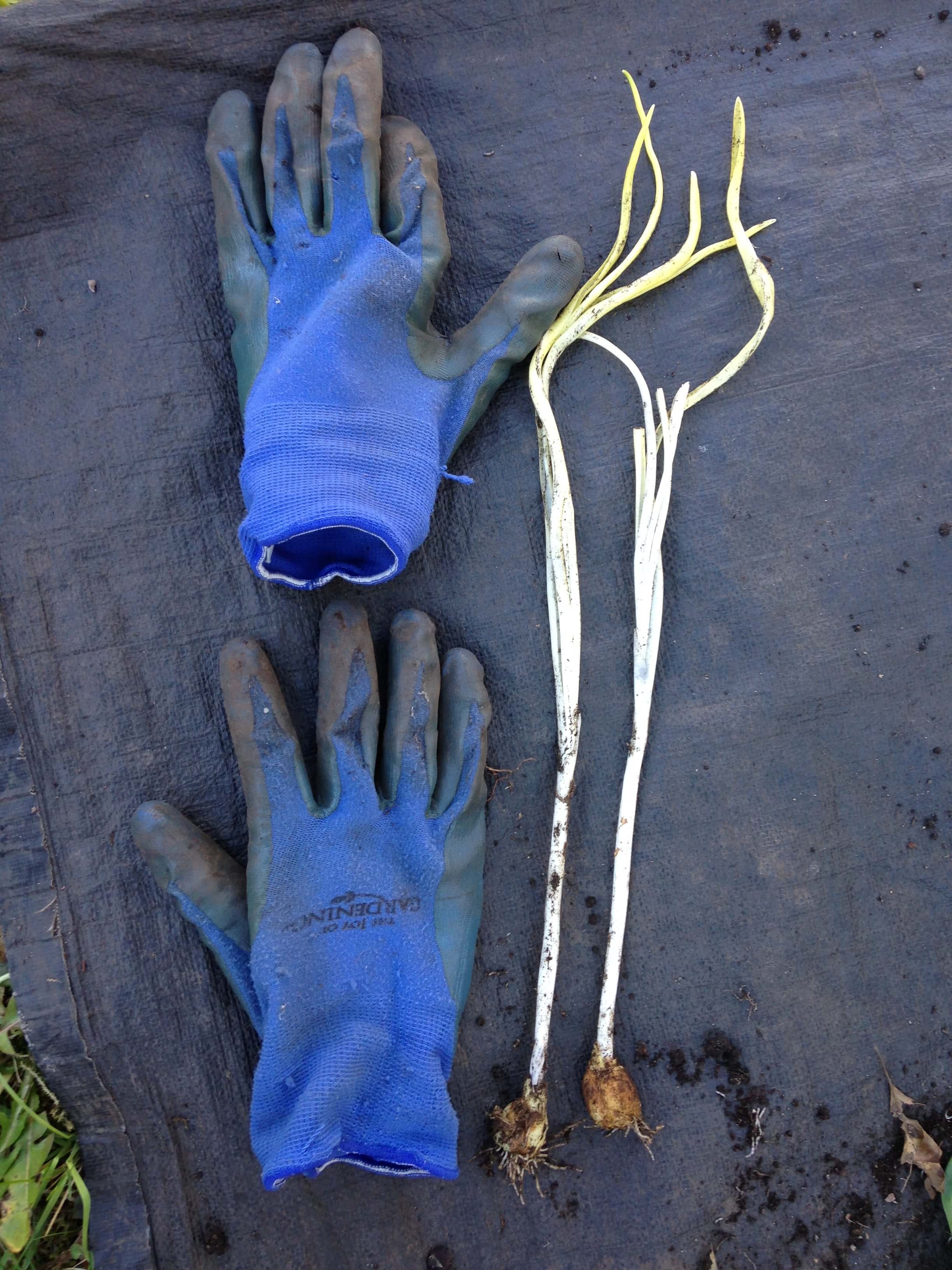
A pitchfork worked well in the moist soil.  Great clumps of bluebell came out.  Apparently, bluebells don’t leave their survival to seed dispersal alone. Each bulb can produce offsets, forming dense clusters.  Clever. Check out how deep some bulbs were! The bluebells in this photo had only just reached the surface of the soil!  That’s a loooong climb through darkness.  Imagine how much energy the bulb had stored in order to grow that much stem in search of sunshine!! (If only we could harness that energy!)
Hyacinthoides hispanica – bluebells spanish blue bells garden Victoria, Vancouver Island, BC, Pacific Northwest
photo by SVSeekins
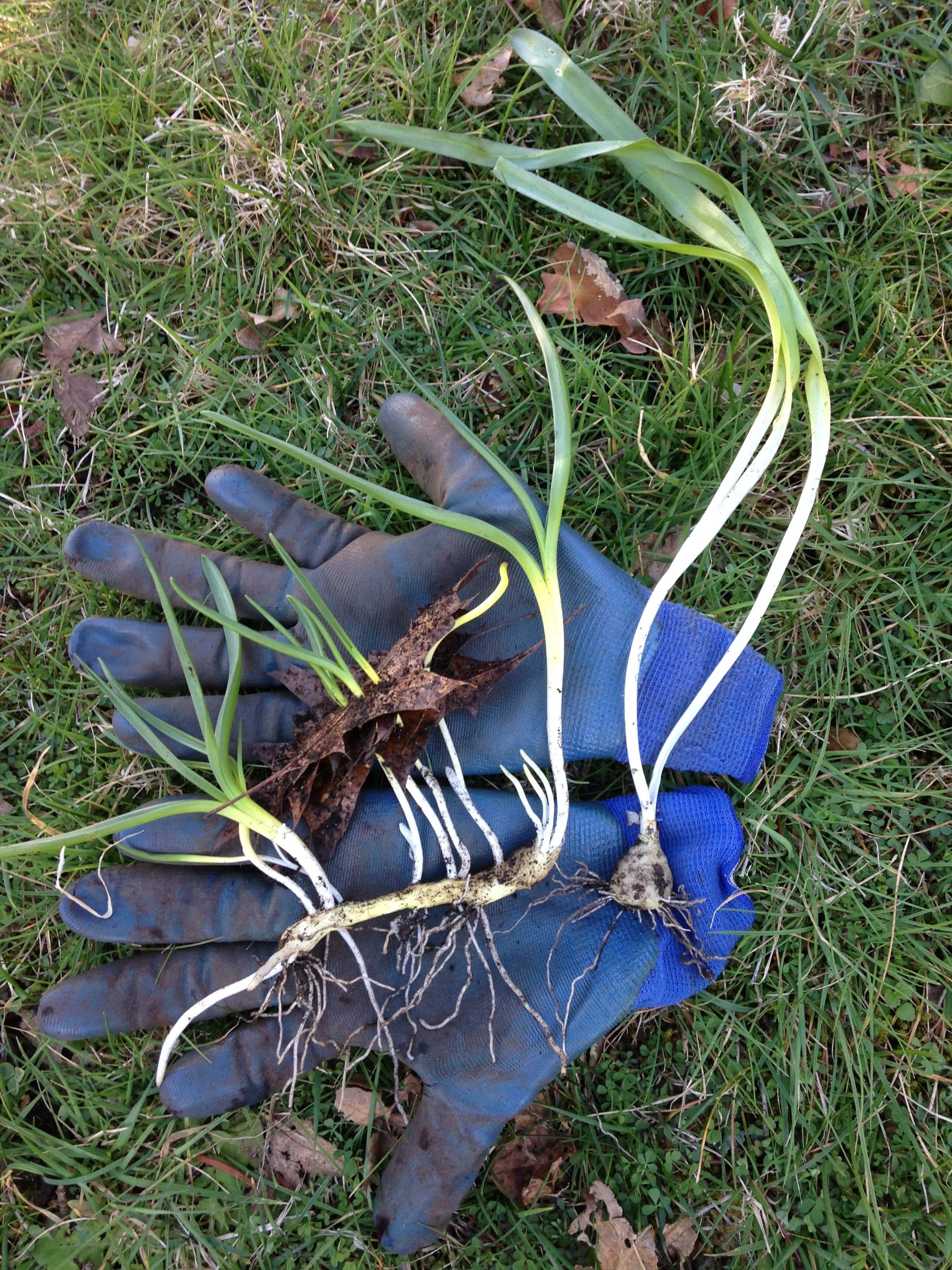
Then…  I started noticing how some of the shoots were creating replacement bulbs closer to the surface.  Isn’t that clever, too?  Another excellent survival strategy. I wonder how deeply a bulb can be buried before it just cannot reach the soil surface & re-establish itself?
Hyacinthoides hispanica – bluebells spanish blue bells garden Victoria, Vancouver Island, BC, Pacific Northwest
photo by SVSeekins
And THEN…  I noticed how some bulbs were sending out ‘runners.’   This is undoubtedly an effective way of increasing its distribution in the bed!  These bluebells are determined to take over.
Hyacinthoides hispanica – bluebells spanish blue bells garden Victoria, Vancouver Island, BC, Pacific Northwest
photo by SVSeekins
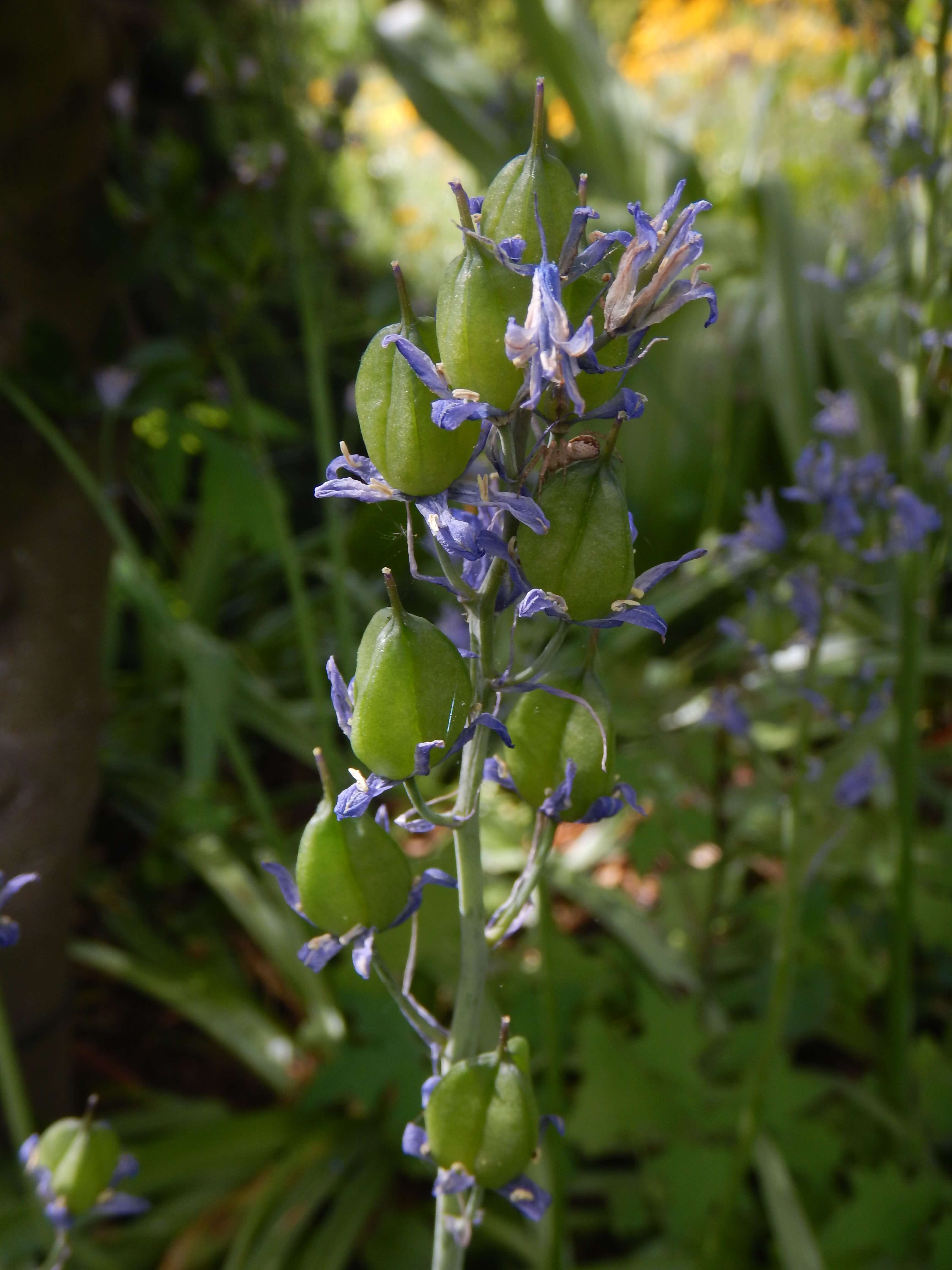
There were masses of new starts– baby plants that likely grew from the seeds that fell last year.   I tried my best to get them all.  But just think about it —  my digging has likely exposed more of the seed bank to the sunshine.  More bluebells are about to sprout. There’s no way I dug out ALL the bulbs.  Many stems broke off, leaving the bulbs deep in the ground.  Hopefully, depriving the bulb of this year’s leaf will starve it enough that it won’t grow next year.  What are the chances?
after the dig - Hyacinthoides hispanica – bluebells spanish blue bells garden Victoria, Vancouver Island, BC, Pacific Northwest
photo by SVSeekins
I’ll continue to pull any that I find this spring.  For now, the bed is clear enough that the other plants have access to the sunshine & a chance to grow. I guess we’ll have to wait until next spring to see how well the effort pays off…
Hyacinthoides hispanica – bluebells spanish blue bells garden Victoria, Vancouver Island, BC, Pacific Northwest
photo by SVSeekins

-30-

Enter your email address to subscribe to this blog and receive notifications of new posts by email.

Other plants that might be considered ‘weeds’:

Wild Yellow Violets

viola glabella, stream violet, pioneer violet, yellow wood violet, smooth yellow violet, wild yellow violets,  Goldstream Park, garden Victoria BC Pacific Northwest
photo by SVSeekins

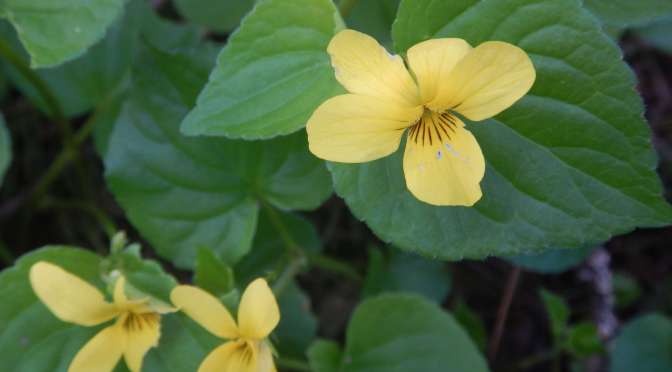
It is on a spring walk through Goldstream Park that we spot wild yellow violets.

So tiny!
But so precious!
(It’s very rare for me to catch sight of this native wildflower.)

It was SM who spotted them.  Once we saw the first one, we noticed a few more further along the trail.

viola glabella, stream violet, pioneer violet, yellow wood violet, smooth yellow violet, wild yellow violets,  Goldstream Park, garden Victoria BC Pacific Northwest
photo by SVSeekins

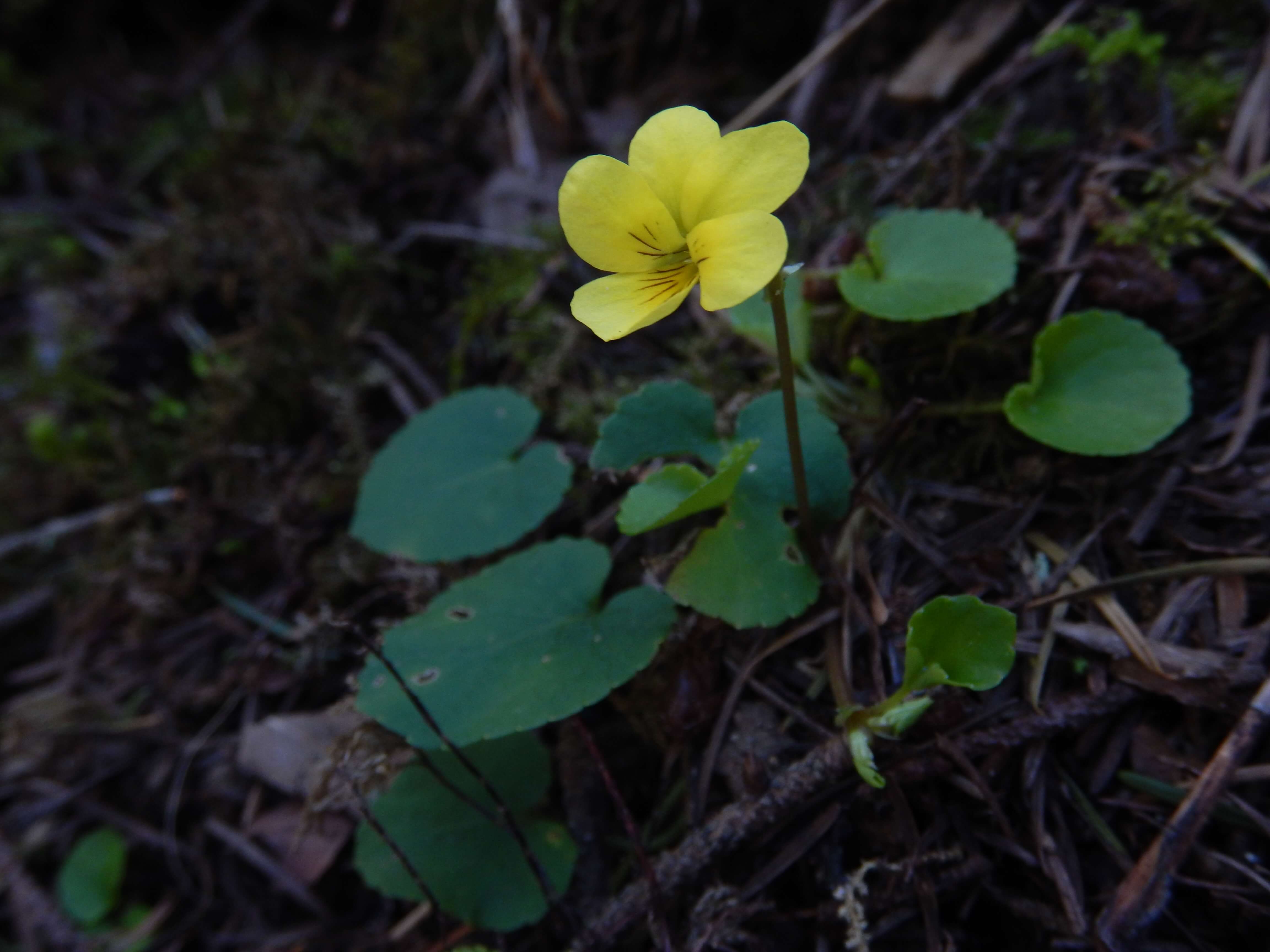
These are Viola glabella, AKA  yellow wood violet, stream violet, pioneer violet,  or smooth yellow violet.

They enjoy the moist woodlands of the Pacific Northwest & are even found along Asia’s Pacific Northeast.
🙂
I wonder how many more names they have there?

Last year I finally saw the endangered yellow montane violet (Viola praemorsa) at Playfair Park.  It has fuzzy leaves & prefers Garry oak meadows. This trailside violet is definitely not it.

viola glabella, stream violet, pioneer violet, yellow wood violet, smooth yellow violet, wild yellow violets,  garden Victoria BC Pacific Northwest
photo by SVSeekins

There’s another similar yellow violet,  Viola pubescens, but it’s native to the eastern side of our continent.   It’s definitely not this one either.

I first encountered yellow wood violets in a municipal campground in Washington State.  Perhaps that patch was more mature, or further into it’s growing season because it was a larger clump.

viola glabella, stream violet, pioneer violet, yellow wood violet, smooth yellow violet, wild yellow violets,  garden Victoria BC Pacific Northwest
photo by SVSeekins

Maybe it was bigger because it had a bit more sunshine?  (Our  walk at Goldstream Park was through lots of tall trees.)

I can easily imagine wanting some yellow wood violets in our own (dry) woodland garden if we weren’t tending a meadow of the western dog violet (Viola adunca).

viola glabella, stream violet, pioneer violet, yellow wood violet, smooth yellow violet, wild yellow violets,  garden Victoria BC Pacific Northwest
photo by SVSeekins

Another friend  (PS) has yellow wood violets in her irrigated woodland garden.  They’re doing well &  are slowly spreading between the other perennials.  The challenge is sharing ground with the more persistent & dry tolerant western dog violet.  They look so similar that it’s only when a dog violet blooms (purple) that PS digs it out, giving the yellow violets priority.  It’s a longterm strategy.  I have my fingers crossed for her.

On second thought, maybe I could find an isolated, shady spot in our yard where there are no dog violets & enough moisture…

-30-