Category Archives: projects

art of creation

Silk Tassel Bush, Garrya Elliptica

There are a few priorities we have for the hedging around our property. I easily get swept up by & fall in love with new, must-have plants. This list reminds me of our conditions… and helps me not waste money by killing off new, unsuitable beauties in our garden.

  • 1 –We want some privacy from the busy street corner, so evergreens are a plus.
  • 2– A solid wall of green hedging can be tedious. Foliage varieties are more interesting to me.
  • 3– A thick telephone cable hangs about 15 feet above our northern border, so we shouldn’t plant anything that interferes with this height restriction.
  • 4– The deer graze through our garden a few times daily, so deer resistance is a factor.
  • 5– The mini-climate on the southern tip of Vancouver Island is Dry Summers & Wet Winters. Our drainage is pretty good, reducing the wet winter threat. It’s dragging the water hose around all summer that’s more work & expense than I’m up for. Drought tolerance is key.
  • 6– Essentially, I’m a lazy gardener, so I prefer low-maintenance choices.
  • 7– And, of course, even though I can be led astray by anything decorative, it’s that ‘decorative’ that makes a garden sing. Some seasonal interest is simply an undeniable factor.
garrya elliptica, silk tassel bush, Wavyleaf Silk tassel, Coast Silktassel, Coast Silk-tassel, Silk Tassel Bush, Wavyleaf Silk-tassel, feverbush, garden Victoria BC Pacific Northwest
photo by SVSeekins

A few years ago, in late February, I was exploring the winter garden at the Horticultural Centre of the Pacific. The Garrya elliptica enchanted me. I wanted one of our own. I NEEDED one… BUT I had to check my list of priorities. (Yes, occasionally, gardeners can show willpower against overwhelming plant lust).
garrya elliptica, silk tassel bush, Wavyleaf Silk tassel, Coast Silktassel, Coast Silk-tassel, Silk Tassel Bush, Wavyleaf Silk-tassel, feverbush, garden Victoria BC Pacific Northwest
photo by SVSeekins

So… How does the Silk Tassel Bush stack up? 
Pretty good, actually.

  • 1 —Evergreen check
    — It is a broadleaf evergreen. Once established, it creates a great background to show off the plants in front of it.
  • 2– Interesting Foliagecheck
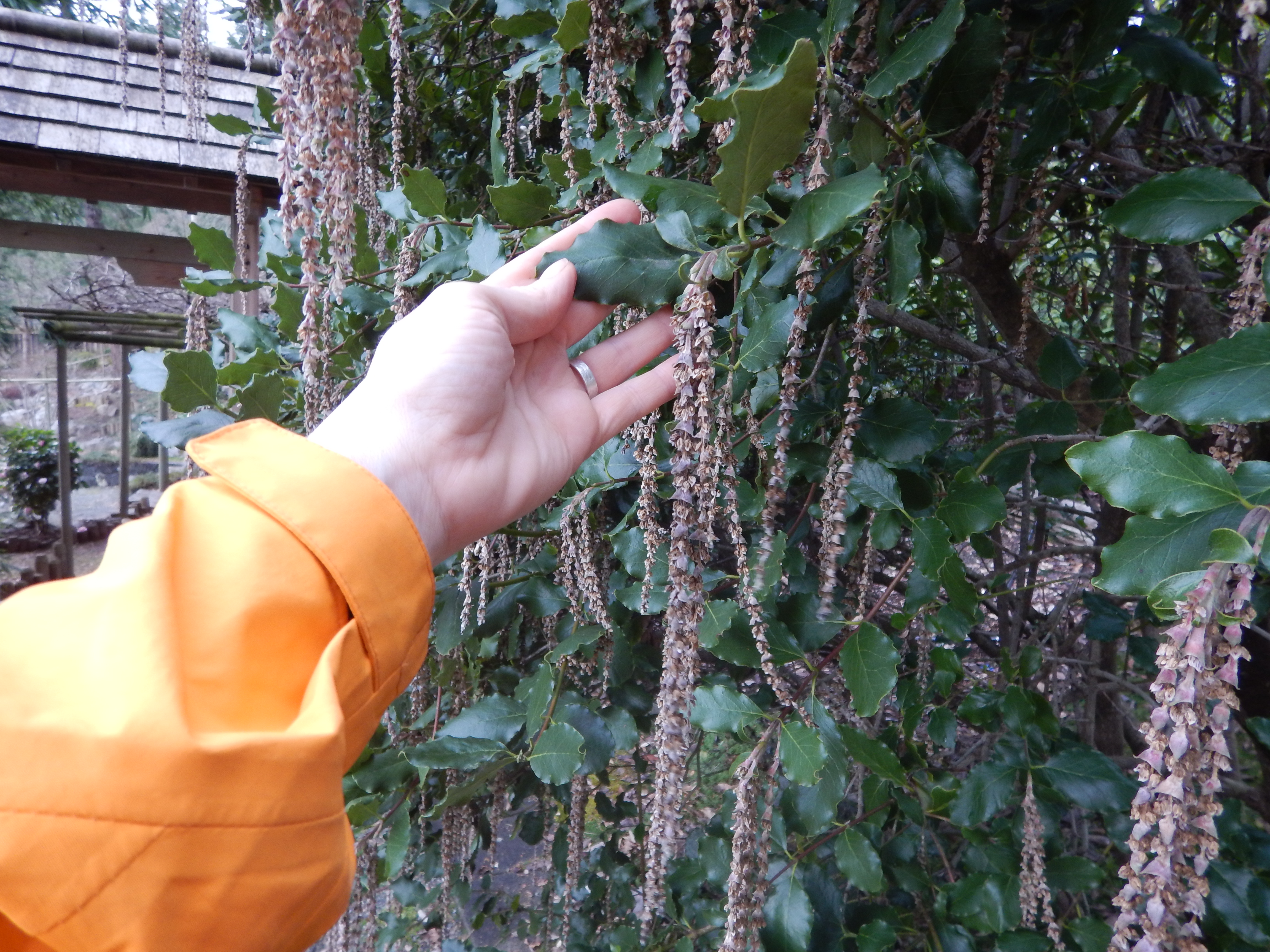
    — The small, oblong leaves are unusual.  They’re shiny & dark green on one side & slightly woolly on the other. The leaf edges are a little bit wavy. They’re different from anything else along our shrub border. That creates interest.
  • 3– Mature Height under 15 feet fingers crossed
    — The specimen at HCP is about 12 feet tall. Most websites I found call G. elliptica a shrub growing about 6-16 feet tall. Others say it can be a small tree that might interfere with our overhanging wires. We could risk that, right? Besides, I don’t water much, & I reckon this will limit the Tassel Bush from getting too big. 
  • 4– Deer Resistancefingers crossed
    — Credible websites say Wavyleaf Silktassel is deer resistant, but I’ve learned that each herd & situation can change that answer. However, these leaves are tough & leathery, something deer tend to avoid unless they’re super hungry. So it’s worth a chance.
  • 5– Drought Tolerancecheck
    — The leaves are also a bit waxy. This hints at its drought tolerance. The Tassel Bush is native to the coastal range of Oregon & California, where it grows in warm, dry conditions. I reckon there’s a good chance this species will naturally migrate north to become native here as our summers get longer & drier. Hopefully, our winters won’t get too much colder — G. elliptica is listed as zone 8, tolerating cold to -23 C (-10 F).
  • 6– Low-Maintenancecheck
    — All the websites I researched said ‘low maintenance’… so it must be true, right? I hope so. The 12-foot shrub I admired that January at HCP was at least 3 feet taller by the following October. I suspect the volunteer gardeners there practice a bit of selective pruning to keep it the size they prefer. I’ll likely be OK with a taller shrub, but I’m also up for getting the loppers out if needed.
  • 7– Seasonal InterestBINGO!
    — The catkins are forming in early autumn. Still, because there’s so much attention on the fall colours, these catkins catch little attention. By January, it’s a whole other story. All winter (and even through April), when there’s little else to marvel over, Garrya elliptica becomes the show. The catkins grow into wonderfully long, striking tassels.

That’s it — Garrya elliptica passes our test.
What else could we want? 

The only thing missing is the assurance that Silk Tassel Bush has wildlife value in our area. Usually, it takes eons of co-evolution for these values to develop. I’ve convinced myself that Oregon & California can be considered ‘adjacent’ to our Pacific Northwest. It’s certainly closer than Asia & Europe, where some species we included in our garden originate.
So why not?

We sourced a Garrya elliptica & installed it along our mixed shrub border.

The Garrya we planted has yet to make itself really comfortable & perform to its best. In a few years, it will look more like the specimen at the HCP. 

With G. elliptica, each plant is gender specific. A male shrub creates only male flowers. A female creates only female flowers. The male catkins are super long compared to females. I don’t know for sure which gender our shrub is, but I’m happy to see the tassels! Time will tell. Either way, I’m pleased with our decision.  🙂

garrya elliptica, silk tassel bush, Wavyleaf Silk tassel, Coast Silktassel, Coast Silk-tassel, Silk Tassel Bush, Wavyleaf Silk-tassel, feverbush, garden Victoria BC Pacific Northwest
photo by SVSeekins

-30-

Landscape a Driveway

I’m hurrying to a new lunch place when I stop short. I’ve never seen this before — but I like it!
How can I make my driveway more appealing?
Here is my answer — landscape the driveway itself.
Genius! And beautiful!

photo by SVSeekins

The rock garden is set smack in the middle of the driveway, leaving the planting safe from the tire tracks on either side. Here’s the following challenge: What is a good driveway plant? The succulents & mossy groundcovers grow low enough that they’re safe as the car’s undercarriage passes above them.

stonecrops, creeping sedums, succulent, driveway rock garden, rockery, crevice garden, garden Victoria, Vancouver Island, BC, Pacific Northwest
photo by SVSeekins

Perhaps the rockery itself also serves to protect the plantings from treads. Situating the creeping sedums in low planting pockets reduces their risk of compaction. Maybe that’s why they’re often called stonecrops?

hens and chicks, Sempervivum, houseleeks, common houseleek, liveforever, succulent, evergreen groundcover,stonecrops, creeping sedums,, driveway rock garden, rockery, crevice garden, garden Victoria, Vancouver Island, BC, Pacific Northwest
photo by SVSeekins

Sempervivum (Hens & Chicks) are tough as nails, too. They happily grow in gravel, forming such tight clumps of rosettes that weeds can rarely squeeze themselves into the party. It’s an added bonus that houseleeks come in many colour varieties.

driveway rock garden, rockery, crevice garden, garden Victoria, Vancouver Island, BC, Pacific Northwest
photo by SVSeekins

Straight through our coastal winter, the evergreen rockery has interest. And with so many foliage colours, can it be called evergreen? Isn’t it more like evercolour? Is that even a word? It should be. There’s so much variety. 🙂

creeping thyme, Thymus praecox, hens and chicks, Sempervivum, succulent, driveway rock garden, rockery, crevice garden, garden Victoria, Vancouver Island, BC, Pacific Northwest
photo by SVSeekins

The drought-tolerant creeping thyme provides background support to the showy houseleeks through the cold months. I envision its mound of bright pink flowers as the headliner through June and July.

Our garden successfully hosts all of these plants. The biggest key to our success is that the neighbourhood deer turn their noses up to all of them. (I’m always thrilled to find something pretty that they won’t browse. )

Was the hardsaper skilled enough to gently slope the bricks toward the central rock garden? The rain could irrigate the plants, soak through the gravel & replenish the water table. Cities are promoting permeable landscapes. This garden is pretty and environmentally friendly.

I’m guessing it’s also a reasonably low-maintenance bed…
occassionally pinching out weeds from between crevices,
sheering spent blooms,
blowing debris away… wouldn’t that be all?
But looks can be deceiving. Next time I pass by, I’m going to knock on the door & ask the gardener. 🙂

-30-

Perennial Hanging Basket

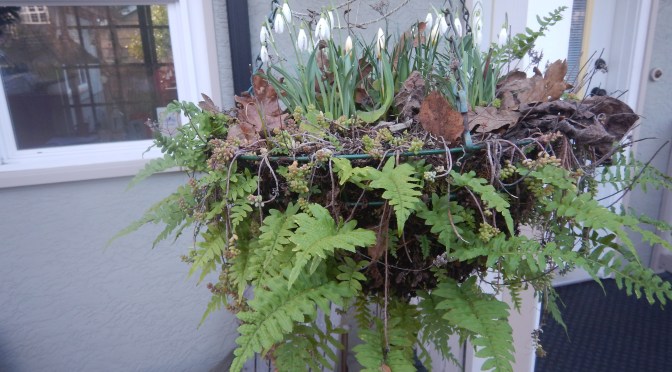
Early last year, I made 2 perennial hanging baskets to rescue licorice ferns. The voracious deer in our neighbourhood were browsing them into oblivion. I peeled the moss & ferns off our rocky outcrop & used them to line the wire baskets. Dangling just out of Bambi’s reach, the ferns are recovering nicely.

Now, my challenge is maintaining seasonal interest in the baskets.

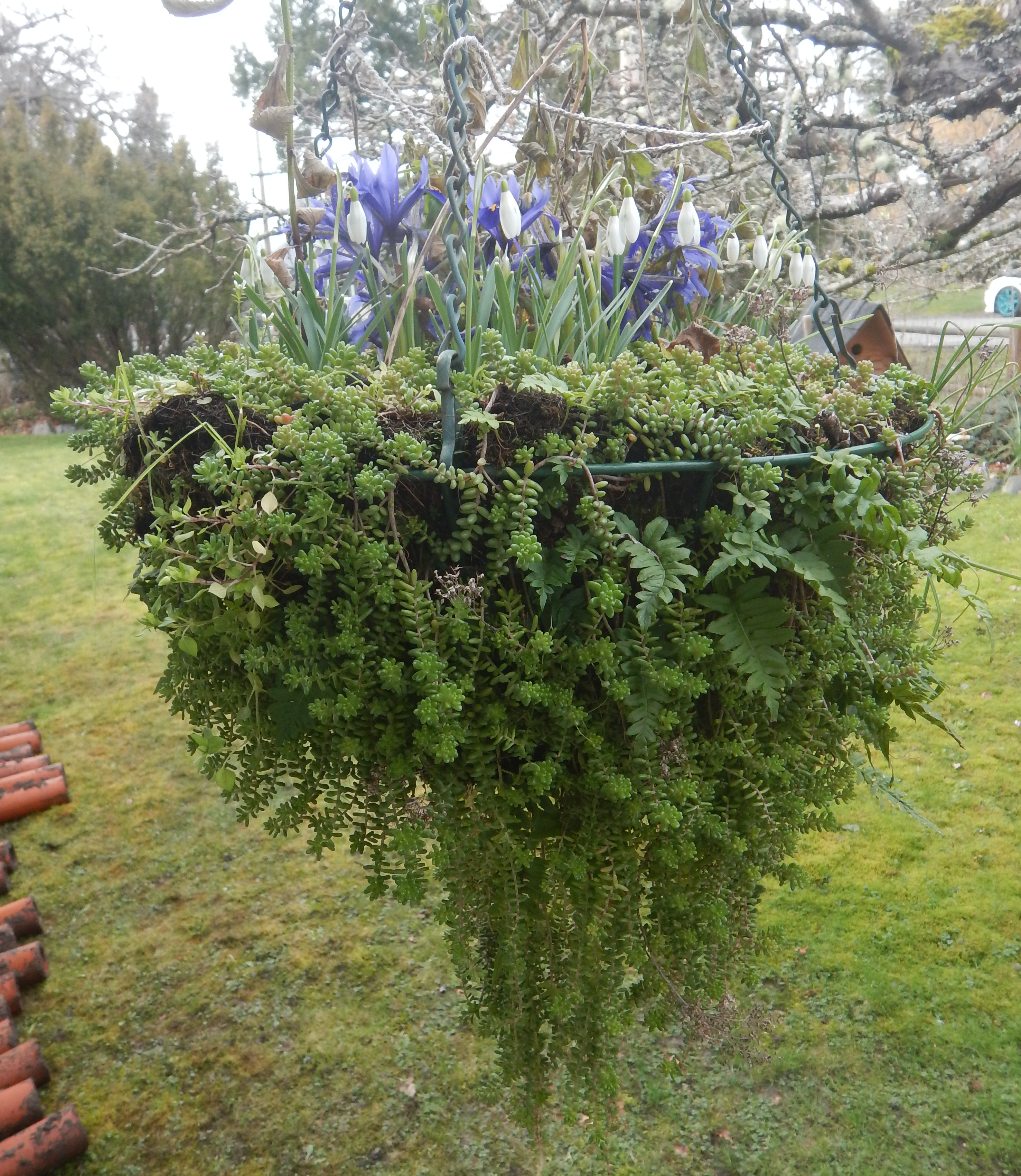
iris reticulata, spring bulbs bloom in licorice fern, perennial hanging basket, garden Victoria, Vancouver Island, BC, Pacific Northwest
photo by SVSeekins

Each winter, I’m desperate for early colour. Because these new containers hang within view of my breakfast table, I look at them with hope. Planting several types of spring bulbs only makes sense.

perennial hanging basket in February snow garden Victoria, Vancouver Island, BC, Pacific Northwest
photo by SVSeekins

Iris reticulata & snowdrops bloomed in early February, just a few months after planting. That got me excited about spring. Then a dump of snow insisted it was still winter.
Bummer. 😦
But the bulbs took it in stride & were still showing off their colours at the end of the month.

iris reticulata, galanthus, snowdrops, spring bulbs bloom in licorice fern, perennial hanging basket, garden Victoria, Vancouver Island, BC, Pacific Northwest
photo by SVSeekins

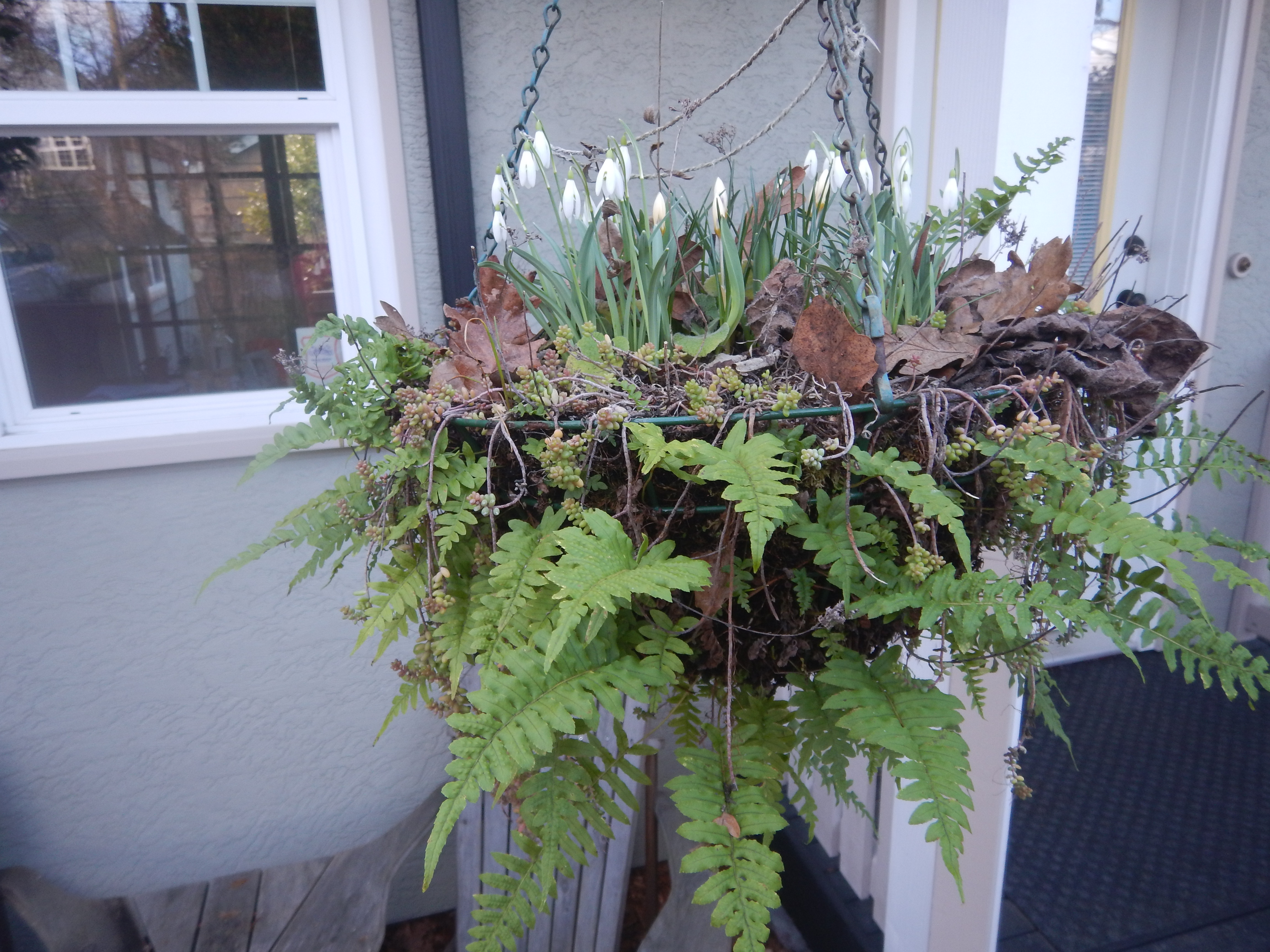
This winter, the snowdrops returned, but sadly there was no sign of the tiny iris. On the bright side, comparing how much the licorice fern fronds grew through the 2 winters without browsing is nice.

snowdrops, galanthus, spring bulbs bloom in licorice fern, perennial hanging basket, garden Victoria, Vancouver Island, BC, Pacific Northwest
photo by SVSeekins

In mid-March of that first year, narcissus, creamy crocus & snowdrops decorated one of the baskets.

galanthus, snowdrops, crocus, narcissus, spring bulbs bloom in licorice fern, perennial hanging basket, garden Victoria, Vancouver Island, BC, Pacific Northwest
photo by SVSeekins

The narcissus carried the show well into April.

narcissus, galanthus, snowdrops, crocus, spring bulbs bloom in licorice fern, perennial hanging basket, garden Victoria, Vancouver Island, BC, Pacific Northwest
photo by SVSeekins

I experimented with some native bulbs in the other basket, hoping to help out the native pollinators & beneficials. Northern Riceroot Fritillary bloomed simultaneously with annual sea blush as the grape hyacinths were finishing up. Through May, the blooms matured and set seed.

Northern Riceroot Fritillary, Fritillaria camschatcensis, northern rice-root, black lily; Kamchatka fritillary; northern riceroot, sea blush, spring bulbs bloom in licorice fern, perennial hanging basket, garden Victoria, Vancouver Island, BC, Pacific Northwest
photo by SVSeekins

By June, the white stonecrop gave me hope for a summer show. The big challenge is finding drought-tolerant plants that survive while we’re away camping.

Sedum album hanging basket, white stonecrop, Oreosedum album , small house leek, garden Victoria, Vancouver Island, BC, Pacific Northwest
photo by SVSeekins

As the bulb foliage died back, I planted a few Salvia seedlings for late summer & autumn interest. Fingers crossed that they’re more established for this year.

Isn’t that what makes gardening so fun? It’s all one experiment after another. 🙂

-30-