More & more often I’m seeing samples of front yards without the classic patch of grass. I’m glad some folks are brave enough to be different.
photo by SVSeekins
This property is on a very busy road, so I totally understand putting up a higher fence than usual. I like the funky heights & angles, and even the color choice. More than that, I like the effort to make the street side decorative.
And then it caught my eye…
photo by SVSeekins
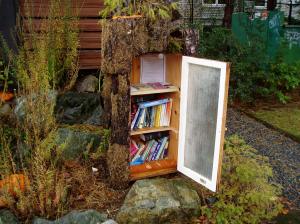
What is going on with that stump with a door in it?
Check it out. This is a new twist on a public library!
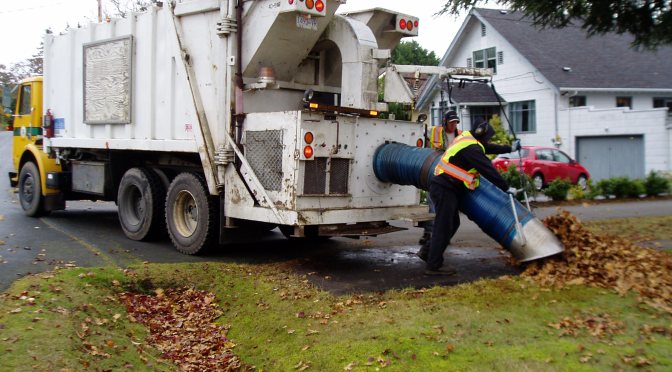
Last year the Parks department hauled away the big leaf pile from in front of my house. They vacuumed all the leaves off Richard’s boulevard, too.
I was happy about it, but Richard had wanted to keep his leaves.
Instead of grass, Richard has planted his boulevard with drought-tolerant decoratives.
photo by SVSeekins
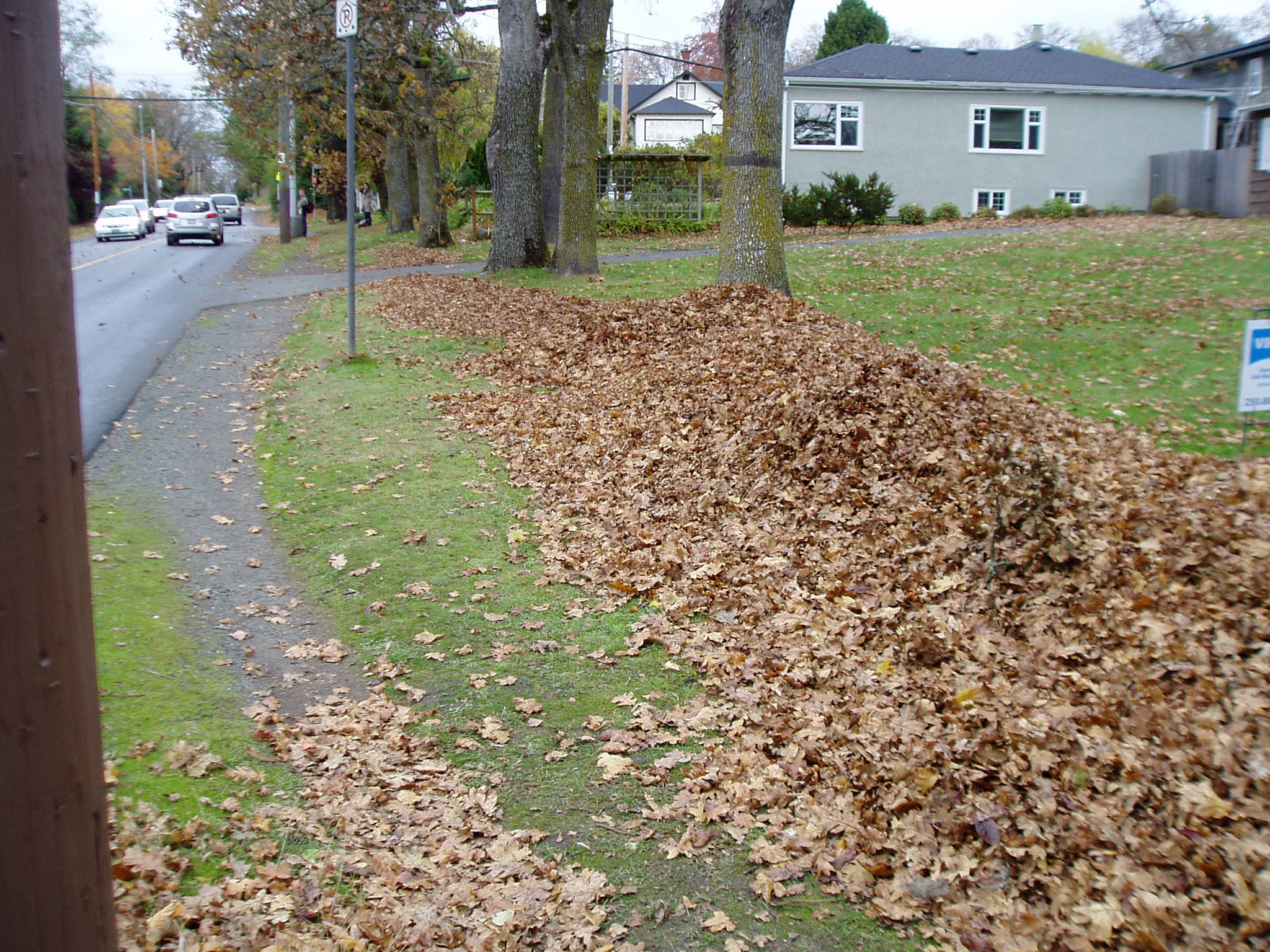
A thick layer of mulch protects against drought in summer, as well as insulating from the cold in winter. Leaves make great mulch, so Richard had intentionally raked his leaves onto the boulevard garden.
I suppose that because most of the perennials had died back for the season, and because Richard had raked the leaves so thickly onto the boulevard, the garden bed was obscured. The vacuum guys must ‘ve thought it was just another curbside pick up.
This year Richard was in his yard when the Parks truck came by. They were thrilled to hear he was making good use of his leaves. Then they asked, “Would you like some more?”
Better still is a big truck delivering them – – free!
It was a win-win.
The vacuum guys saved themselves a trip across town to unload.
Richard got free mulch – – 2 big truckloads of it!
A couple of years ago, Richard had a dirt-mart deliver a couple of truckloads of mulch (about the same amount). It cost $800.
I’m told the Parks Department accepts requests for leaves, and are happy to schedule a drop off when they’re vacuuming in the neighbourhood.
photo by Judy Atkinson
Of course, there’s still the chore of moving it all from the driveway & into the beds. That’s a whole lot of wheel barrel trips.
Indeed, a big task is less daunting when shared with friends. It was fun to pitch in. It was also excellent exercise. 🙂
As long as I’ve known Richard as a gardener, he’s never been shy about mulching the beds. It always looks a little thick to me.
photo by Judy Atkinson
Over a couple months, the heavy rains will compact all that mulch down. The spring bulbs will be shooting through it. I’m really looking forward to seeing that.
But for now, I’m thinking of calling Parks for myself.
In the downtown core of BC’s capital city, I’m glad there are some spots where pedestrians enjoy some separation from the vehicle traffic as they all go about their busy schedules.
photo by SVSeekins
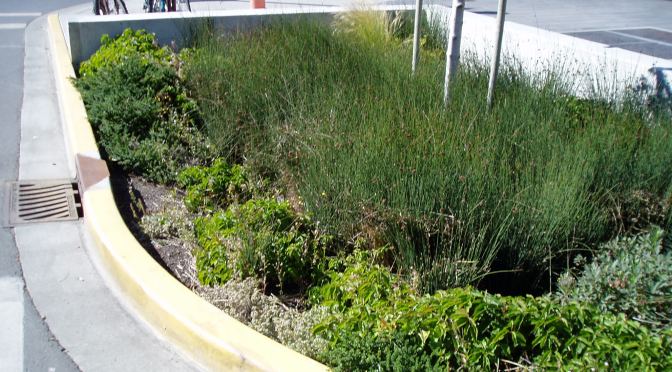
But in this spot, on the northeast corner of Yates & Blanshard streets, it’s more than just a pretty boulevard. Here nature is working hard as a public utility: a rain garden.
Most cities have been done with ditches for ages, favouring underground storm drain systems to pipe rainwater away quickly. Although that sounds pretty civilized, it means:
water drains so fast that there’s no time for it to soak in and nourish boulevard trees & landscaping, much less refill the natural water table
street pollution washes into the storm system and then dumps directly into streams or the ocean
in heavy rains, the storm drain system can’t handle the rush of runoff, so streets flood anyway
photo by SVSeekins
The rain garden acts as a bit of a pond containing the flow for a small rain event (about 2.5 cm rainfall). That’s the amount that washes the oils & chemicals off the street.
The trees, plants, and soils in the ditch are not only nourished, but they also break down the pollutants before the water infiltrates more deeply into the earth beneath.
It sounds kinda crazy that plants can break down pollution, doesn’t it? Science swears it’s true.
photo by SVSeekins
In a heavier rainstorm, the runoff gathers in the rain garden, and the excess water flows more slowly away in that handy storm drain system.
It sounds like a win-win situation to me.
The rain irrigates the garden naturally.
Pollutants are treated by an effective process.
There’s less flooding now & the storm drain system won’t need expensive pipe enlargements to handle the increased rains we’re getting over the past few years.
photo by SVSeekins
I especially appreciate that the gardens provide some natural beauty to an otherwise glass, steel & concrete desert.
Now the curiosity rises in my mind: which trees & plants thrive in one of these ditches? They’d need to be happy with both very wet feet in winter and very dry in summer…. ideas?








 Garden Variety Life