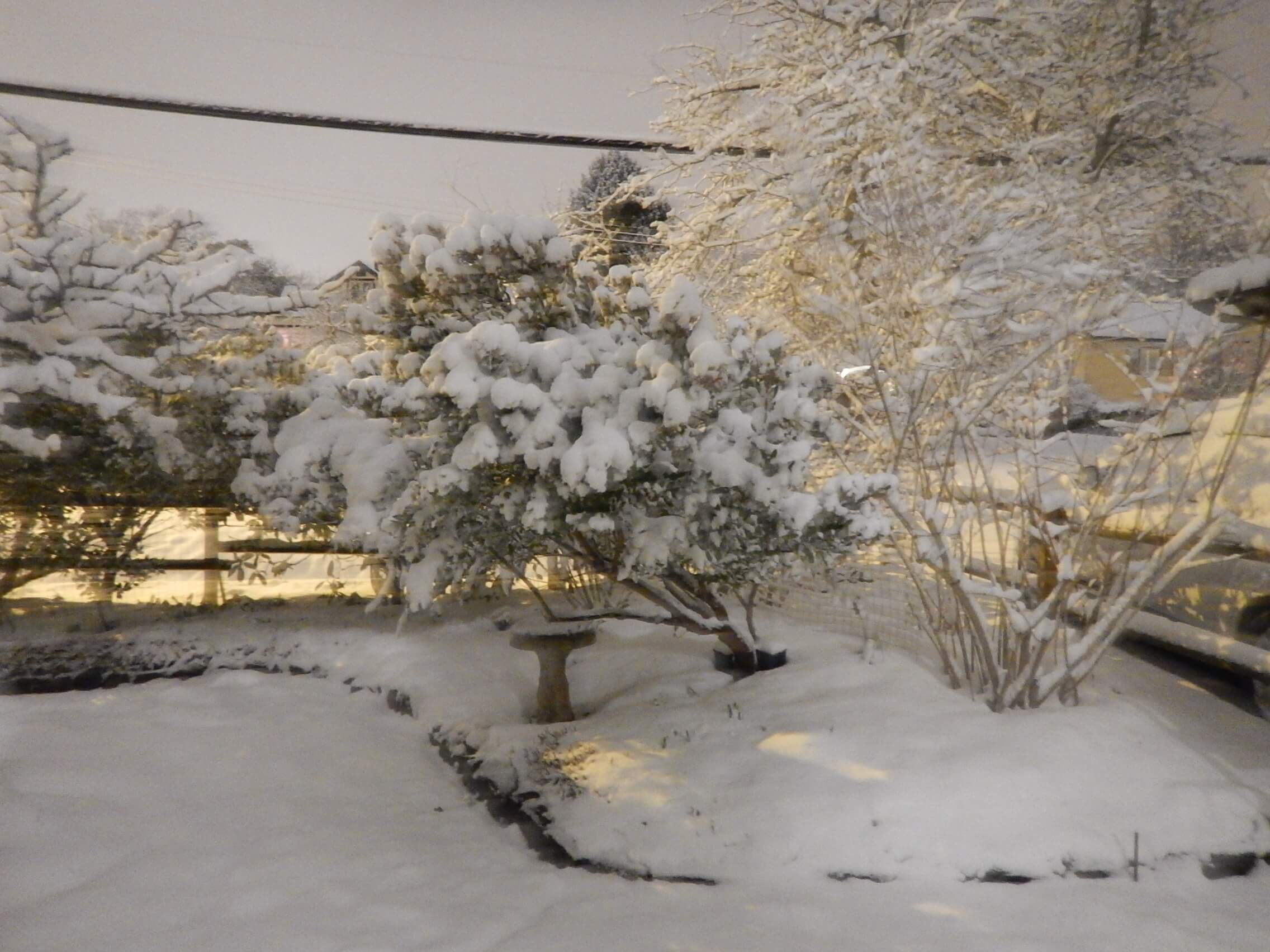
This is not normal for Victoria. The snow might be pretty but this is a rain-forest. We’re not set up for snow. Neither are our gardens.
photo by SVSeekins
Tonight’s concern is the snow load on the hedging. It’s amazing how flexible some branches can be as snow gathers & literally weighs them down. But some wood fibers are breaking as the branches bend. The sooner the weight is removed, the more likely a branch is to bounce back & resume its regular shape for good.
photo by SVSeekins
Out comes my trusty rake. Wielding it backward, I thrust the pole end into the lowest branches & give the shrub a light shake.
It’s best to start low & gradually work up. Release the load from lower branches before risking adding more to them with the snow falling off upper branches.
photo by SVSeekins
Once broken, there’s no mending a branch. All those years of growing into a full-sized shrub…
the lovely shape…
our increased privacy…
can be ruined overnight. Heart-wrenching.
photo by sVSeekins
Although hedgers like yew & cedar are especially susceptible, same goes for the broadleaf evergreens. Rhododendron.
Strawberry Tree.
Camellia.
Flower buds are already well-formed on the rhodos & camellia. So if I want many blooms this spring, it requires a delicate shake to remove the snow & only the snow.
After that, it’s good to head inside, dry off & treat myself to a hot chocolate (with Frangelico). After all, it’s a dark and snowy night…
Back in the ’60s, Mom was a member of the Silver Valley Ladies Club.
Silver Valley Ladies Club Canadian Centennial Friendship Bedspread. Photos by SVSeekins
These days, a Ladies’ Club seems very old-fashioned. I’ve no idea what their official mandate was. I figure it was equivalent to the currently popular Book Club: women gathering to socialize & complete projects.
One of the projects that Mom & her peers created was the 1967 Canadian Centennial Friendship Quilts. Actually, they nixed the outdated quilt idea and opted for the trending bedspread instead.
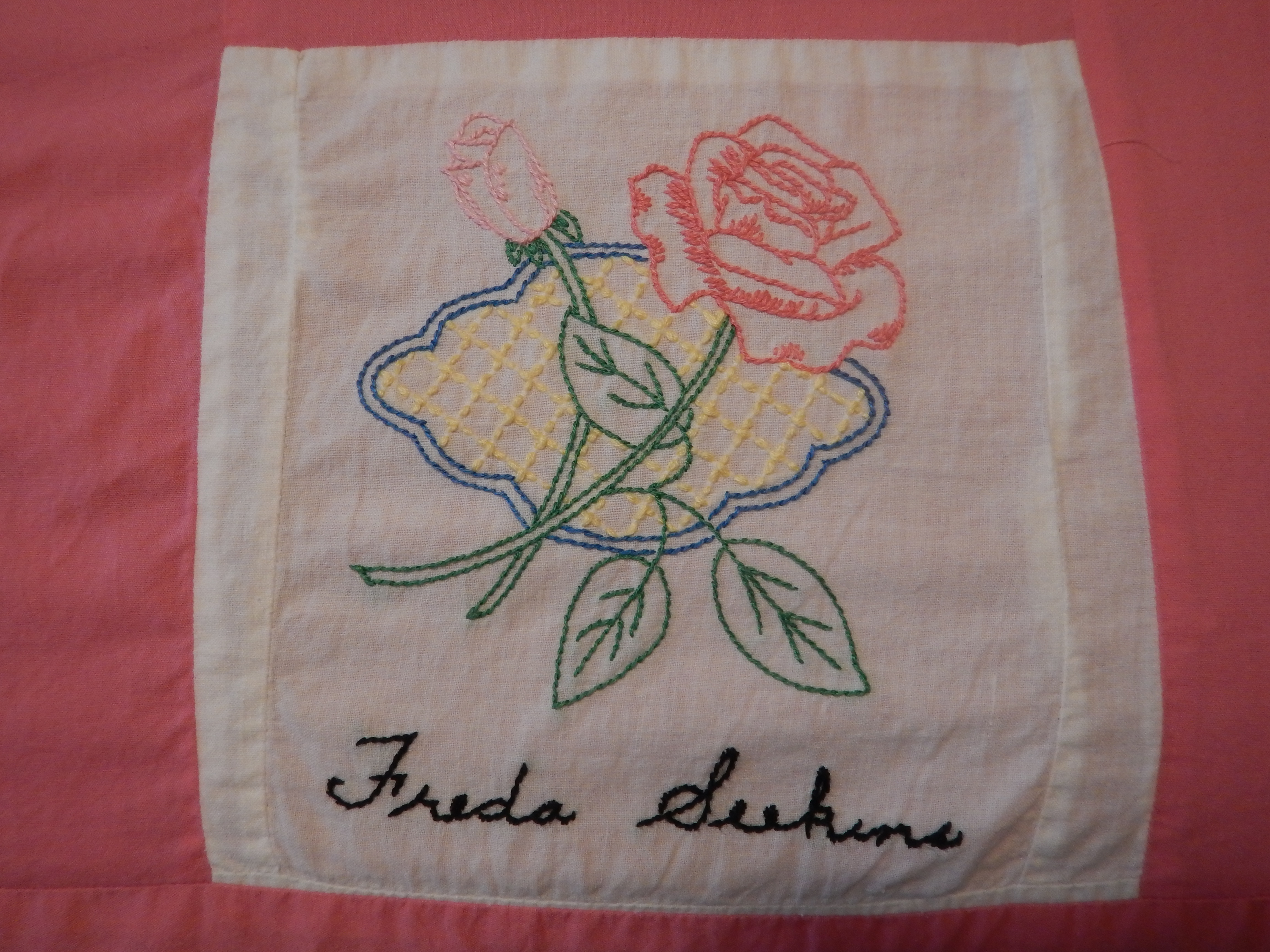
embroidery by Freda Seekins
Each bedspread consisted of 24 personally embroidered squares. For just one lady, it seemed a daunting task to stitch that many squares, much less sew them all together into a finished product. So what the club did was divide and conquer.
embroidery by Evelyn Fox
Each month, the club gathered. Each member brought a square of embroidery she’d completed. Together, there’d be enough squares to create a bedspread. It was sewn together & the finished product would inspire the excitement to do it all again the next month.
embroidery by Jessie Derksen
By the end of the year, every member of the club had a Friendship Bedspread. Pretty cool, eh?
Mom cherished hers — so much so that she could barely bring herself to use it. I remember her stretching it out on the bed so I could check out each personalized square.
embroidery by Helen Dyck
Mom had embroidered a rose on her square — rose was her favourite scent.
Evelyn (+ Claude) Fox lived just south of us. They were one of the first young families to homestead in Silver Valley. They and Claude’s folks had filed claims in 1952. Building a farm from scratch was tough going. To make ends meet, the Fox brothers returned to Slave Lake each winter to work their sawmill.
embroidery by Ruby Fox
That same year (’52), the Franks & the Frostads also worked their land.
Jessie (+ Aron) Derksen homesteaded in Silver Valley in the early years (’53). I wonder if Jessie was a founding member of the Ladies Club?
embroidery by Sharon Dyck
Helen (+ Jake) Dyck filed for a homestead in 1953, shortly after my grandparents, Elsie + Joe Seekins. It took a year or two before Helen brought the whole family out. So started the ‘Dyck clans’ — 3 unrelated Dyck families creating farms within a few miles of each other.
Helen’s daughter, Ruby, wed Harry Fox, of the ‘Fox Brothers’ Sawmills.’ I recall babysitting Ruby’s son, Tim, and still tease him about that.
embroidery by Tina Remple
Jessie’s daughter, Sharon, wed Helen’s son, Harry Dyck. Sharon had the best strawberry patch out of anyone I knew.
Tina (+ Dick) Rempel also claimed a homestead in Silver Valley in ’53. They lived a few miles northwest of us beside a steep coulee. That coulee made the most incredible tobogganing slope. I barely remember their older kids, who hung out with my Uncle Rick. Tina + Dick also fostered siblings Corena, Nancy & Jerry Moses. They were great friends of ours.
embroidery by Justine Remple
Justina (+ Bill) Rempelmoved to the Valley at the same time as his brother Dick (+ Tina). They built homes within a mile of each other.
The Morrison contingent claimed land about a mile further on, past the Rempel’s. Astrid (+ John W.) Morrison helped out at their sons’ 3 homesteads.
embroidery by Astrid Morrison
Verna (+ Doug) Morrison set up house in ’54 in what was basically a granary. Like many homesteads, the granaries were built first. Folks lived in them during the summer, then moved to town each autumn, after the harvest. Once there was something more like a real house, families were able to stay on their land year-round.
embroidery by Verna Morrison
Aganetha (+ John H.) Dyck accompanied Helen (+ Jake) Dyck on their adventure. In ’55, they moved to the Valley with 8 of their 11 kids. They were all hard workers but knew how to have fun along the way.
embroidery by Aganetha Dyck
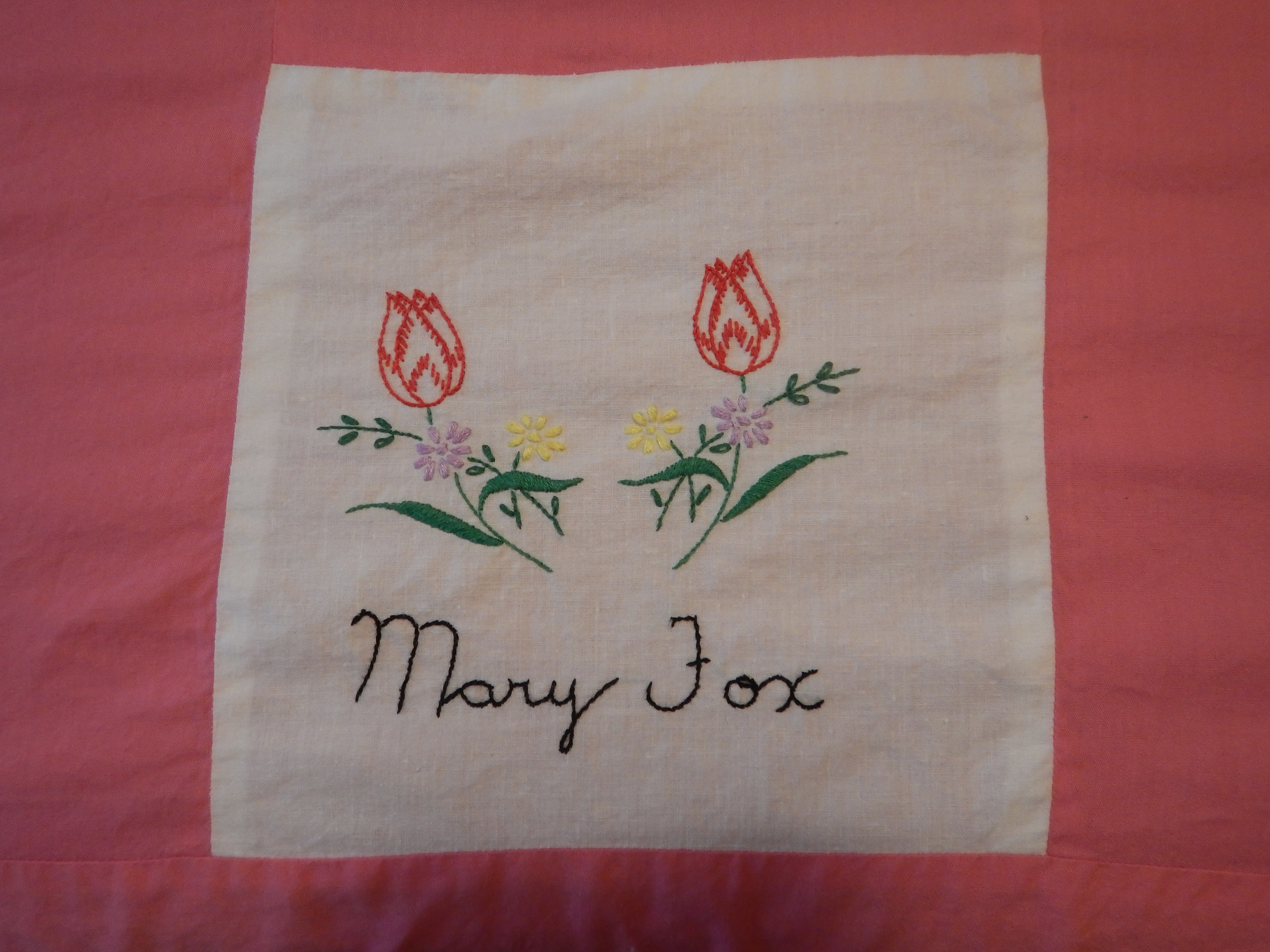
Aganetha’s daughter, Mary, wed Dick Fox(of the above-mentioned Fox Brothers Sawmill fame). Mary + Dick lived a few miles southeast of us. Mary’s daughter, Kathy, and I were in school together from kindergarten through grade twelve. Kathy still lives in the area. Last year, when Dad sold our farm, I was in the Valley during Mary’s celebration of life. I learned that Mary favoured roses, just like Mom.
embroidery by Mary Fox
Aganetha’s daughter, Susie, wed Dwayne Frostad. (Son of Myrtle & Earl, homesteading in ’52) The Frostads were one of my favourite neighbours to visit. Susie had 5 daughters, all fun kids. My brother Mitch was in the same grade as Bonnie Frostad. Once, he named a new milk goat after Bonnie, intending it to be a great honour.
embroidery by Susie Frostad
Aganetha’s daughter, Helen, wed Jessie’s son Gordon Derksen. Helen hosted the first telephone in Silver Valley. Folks would drop by if they had a desperate need to get in touch with the outside world. Helen was a great tailor. I chatted with her son, Melvin, last year. He’s still a Valley resident. He echoes Helen’s laugh & wicked sense of humour.
embroidery by Helen Derksen
Ruby (+ Len) Lofgren started breaking their land in ’57, then moved onto it in ’60. Ruby homeschooled her kids for a year. Then Len took the new job of school bus driver. He drove the Silver Valley kids, including my Uncle Rick & Aunt Star, to the Fourth Creek School. It wasn’t until ’65 that our local school opened.
embroidery by Ruby Lofgren
Jantje (+ Dries) van Norel emigrated from Holland to Silver Valley via Lethbridge. Her accent was so strong that I never understood more than a few words in any of her comments. Her tone of voice was always kind, though.
embroidery by Jantje van Norel
Jantje’s daughter, Betty, wed Corny Knoot, who had followed her from Holland. They set up their home in the same yard as Jantje. They farmed the land across the road from the original Lassiter Camp (the post-war federal project that surveyed & made the cut lines delineating land parcels). That camp eventually became the home to the Silver Valley Community Hall, where the Ladies Club held their meetings.
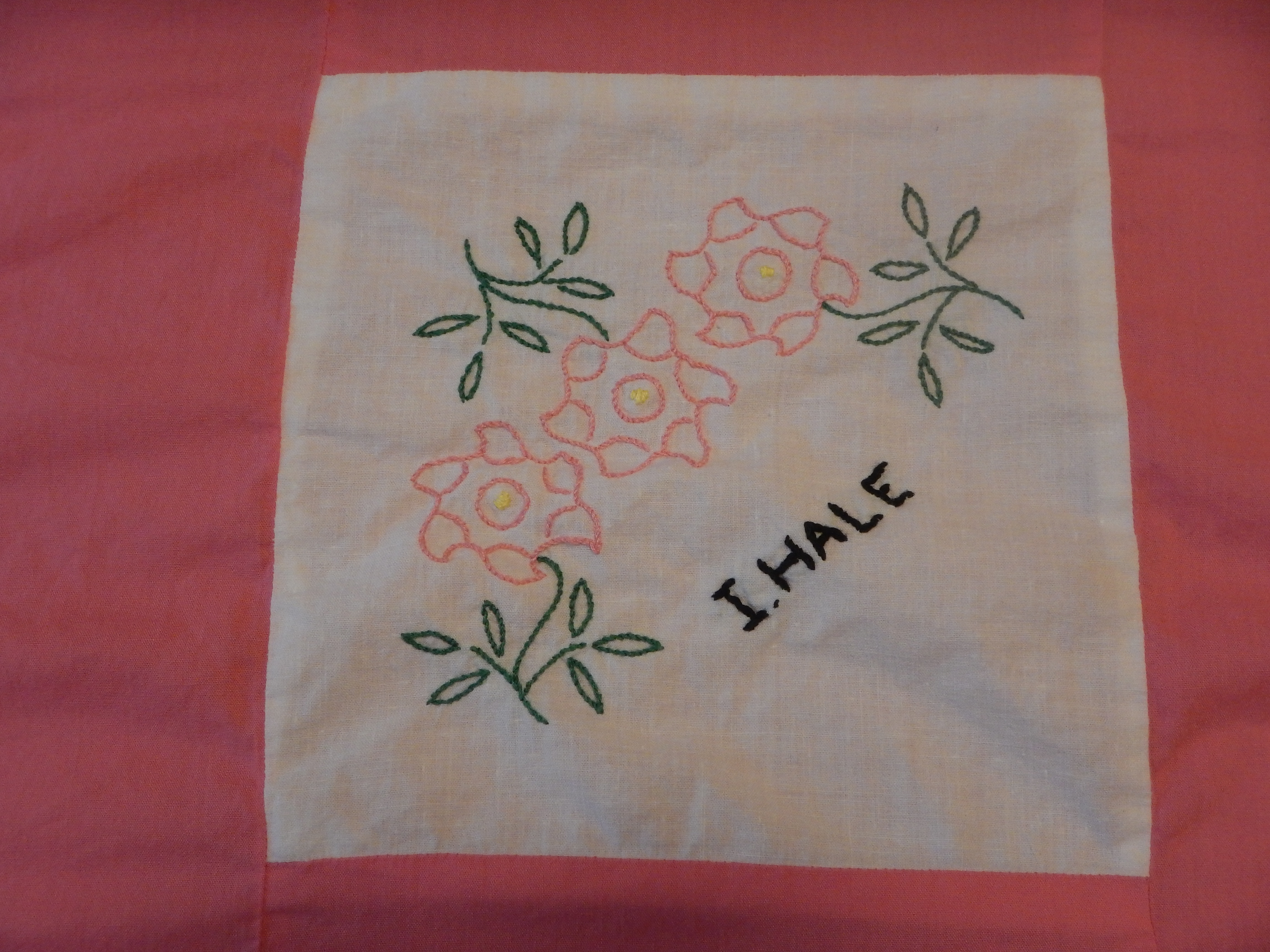
embroidery by Irene Hale
In 1964, Betty Knoot started Alberta’s first chapter of the Girl Forest Guards. The group met at the Silver Valley Community Hall, eventually becoming co-ed as the Junior Forest Wardens. Many of my camping skills were developed through that club.
embroidery by Donna Boucher
Irene (+ Jim) Hale were the first homesteaders in Silver Valley to successfully make a living raising bees. Their biggest challenge was all the bears. Most farmers kept some fields in clover to improve the soil. I was always thrilled when Hales rented a patch of our field for hives because they paid us in honey. So sweet.
embroidery by Audrey Rehaume
Donna (+ Rolly) Boucher came to Silver Valley in 1961, along with the Hales. Their kids were our age, too, so I enjoyed visiting. My earliest memory was that Donna made the BEST cookies, Rickety Uncles. Later on, she became a school bus driver, which I thought was pretty cool. Even cooler was that Donna was the first adult I knew to go back to school & graduate from high school. Many homesteaders didn’t have the luxury to graduate high school, much less go to college. (My Dad followed her example years later)
embroidery by Jean Scarrow
Audrey (+ Bill) Rehaume filed their land claim in ’62. Back in the day, the roads were pretty bad. Sometimes Audrey arrived at Ladies Club meetings driving their trusty tractor.
Jean (+ Andy) Scarrow decided to homestead after his sister, Audrey Rehaume, passed on the adventure bug. They settled on a parcel of land just north of my grandparents’ place. Our families used to visit & play cards. Neighbours played a lot of card games back then. Electricity hadn’t come to the Valley yet, so there was no zoning out for nights on end, watching TV.
embroidery by Leona Ritchie
Leona (+ Mason) Ritchie won their homestead draw in 1963. Their land was halfway between Ruby Fox and Helen Derksen’s. I remember Leona leading the 4-H Sewing Club when I was in my teens. She hired me for my first paid job outside of babysitting: picking rocks! Sometimes it seemed like young fields sprouted more rocks than anything else. Rocks were hard on the farm machinery, so we moved them out of the way.
embroidery by Evelyn Frank
Evelyn (+ Benny) Frank had one of the early homesteads, but they were ‘summer farmers ‘ until they moved the family out to the Valley full-time in ’65. Evelyn became our local hairstylist because she was confident enough to try more than the classic ‘bowl’ haircut.
embroidery by Doreen Petersen
Doreen (+ Marvin) Peterson’s application for a homestead in Silver Valley was awarded in 1963. After the 3rd summer, they stayed on the land full-time.
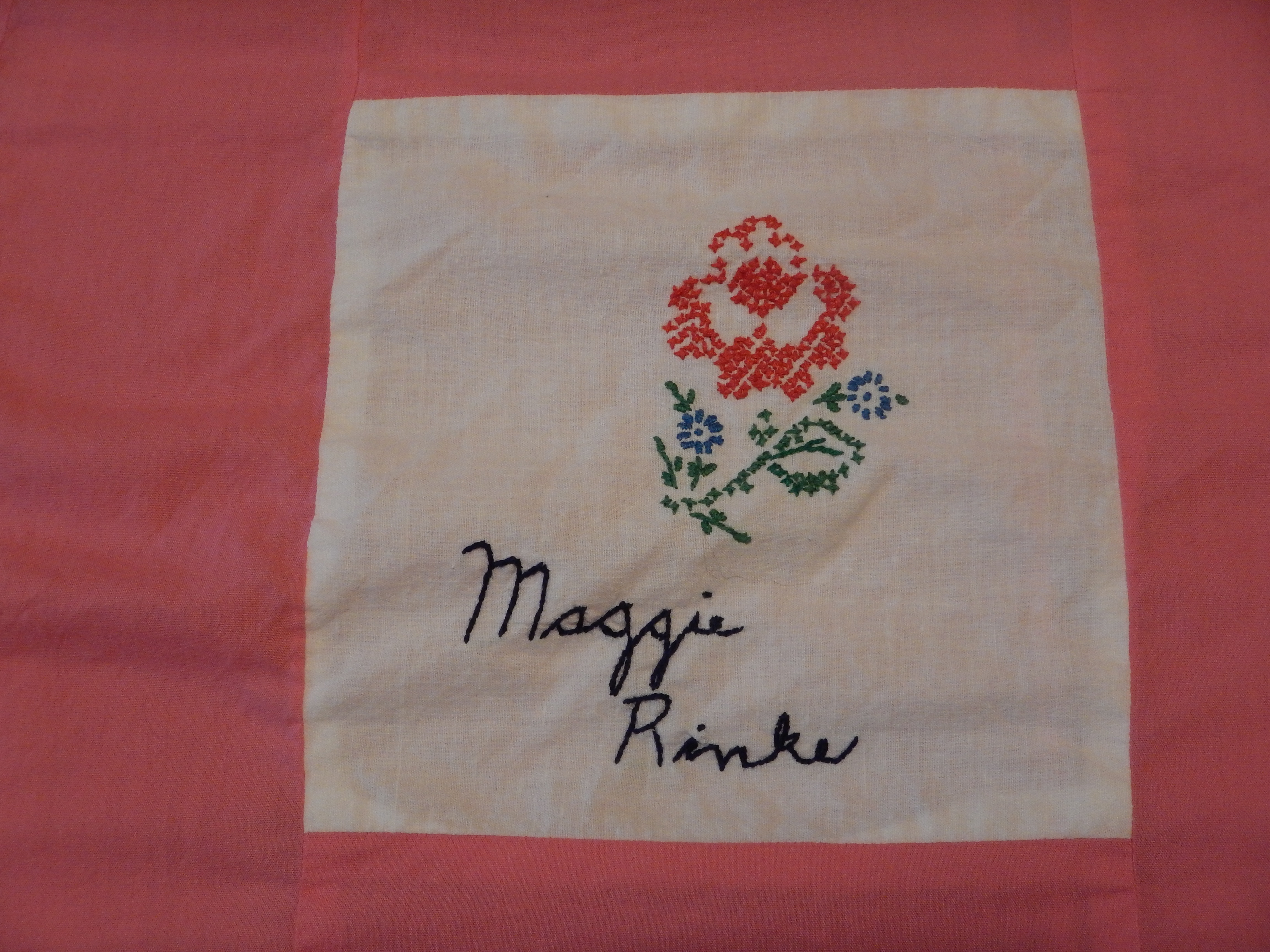
To be honest, I don’t remember who Maggie Rinke was, even though she embroidered a square on Mom’s Centennial Friendship Bedspread. Something tells me she was related to the Rehaumes… maybe? Silver Valley was such a small community that everybody knew everyone else. My memory is to blame for drawing a blank, which isn’t surprising, as I wasn’t even in kindergarten in 1967. So, I’ve been scouring the history book Tales Trails & Gumbo (c.1991) for clues. No Rinke families are listed. But Sharon Dyck mentions a John Rinke in relation to a school closure. Perhaps Maggie and John were school teachers?
embroidery by Maggie Rinke
Mom tucked her friendship treasure away, covering the bed with the old chenille bedspread, which she wasn’t as worried about getting dirty or wearing out. I have vivid memories of lying on top of the bed, staring at the rows of chenille & slowly pulling out tufts in a pattern, creating road maps on the blanket. Mom knew what she was doing. Even then, I was a creative child.
-30-
Late-Breaking News-– a friend has tracked down & shared the great cookie recipe 🙂
RICKETY UNCLES
1 cup butter
1.5 cups brown sugar
4 cups rolled oats
2 tsp vanilla
pinch of salt
Melt butter, mix in all other ingredients, pour into the pan and press flat. Bake at 350°F for 25 minutes. Cool for 10 minutes, then cut into squares while still warm.
-30-
Silver Valley Ladies Club Canadian Centennial Friendship Bedspread, photo by Laura Ritchie
“Danish Butter Cookies” is one of my favorite Christmas baking recipes*. I like to use it as a warm-up for some of the more serious baking.
photo by SVSeekins
YOU’LL NEED:
1 cup butter 1 cup sugar 1 egg 2 cups flour
TIP: The key to this recipe is to have the ingredients at cool room temperature.
If the butter is straight out of the fridge, it’s too cold. BUT too warm isn’t good either.
photo by SVSeekins
Forget about microwaving the butter for just a few seconds to take the chill out. The result is lovely, smooth dough which mushes into a mess in the oven.
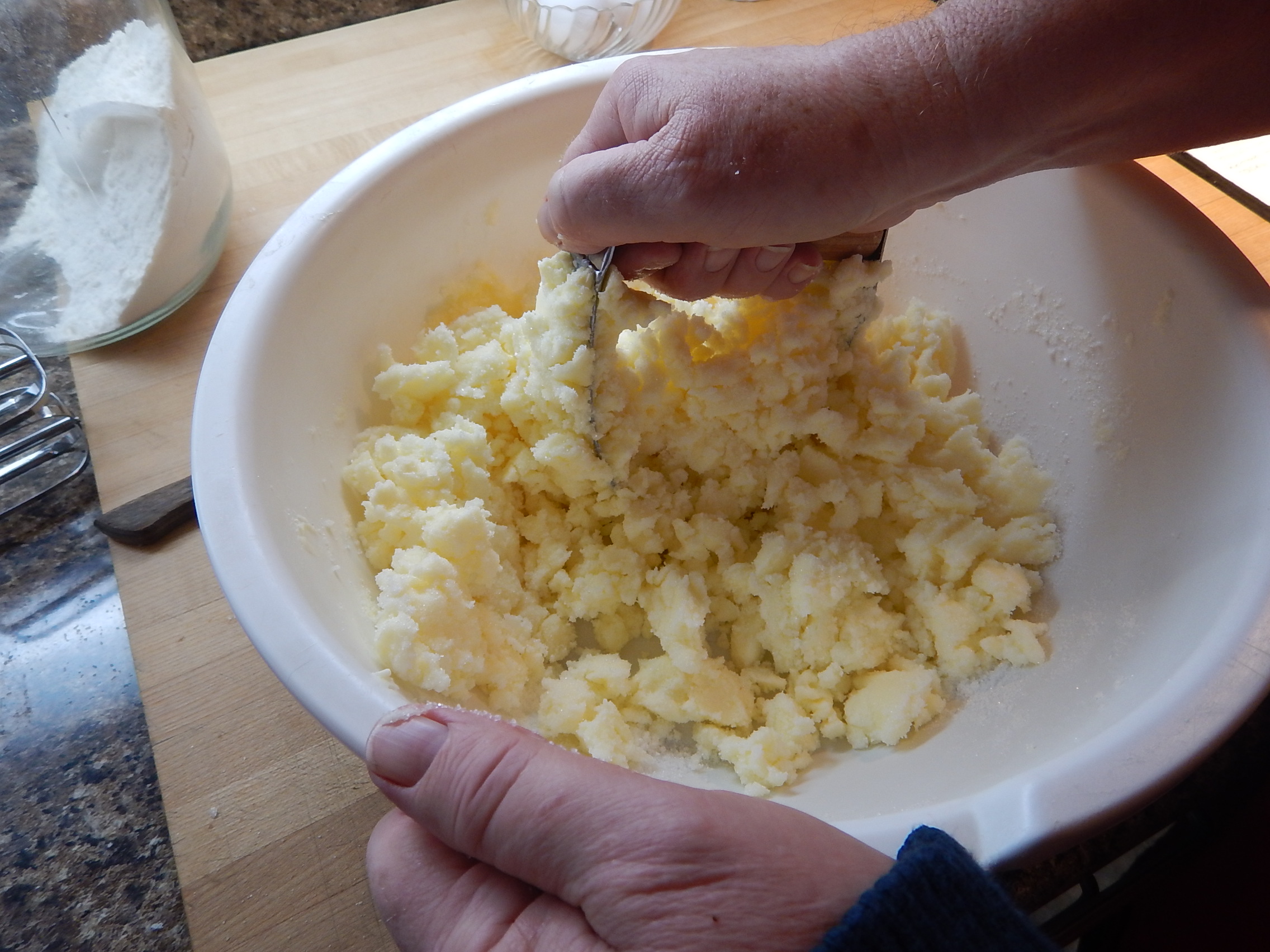
I’ve learned to keep my hands out of the dough for the same reason.
STEP ONE – Cut the butter into small pieces. Add the sugar. Mix well.
photo by SVSeekins
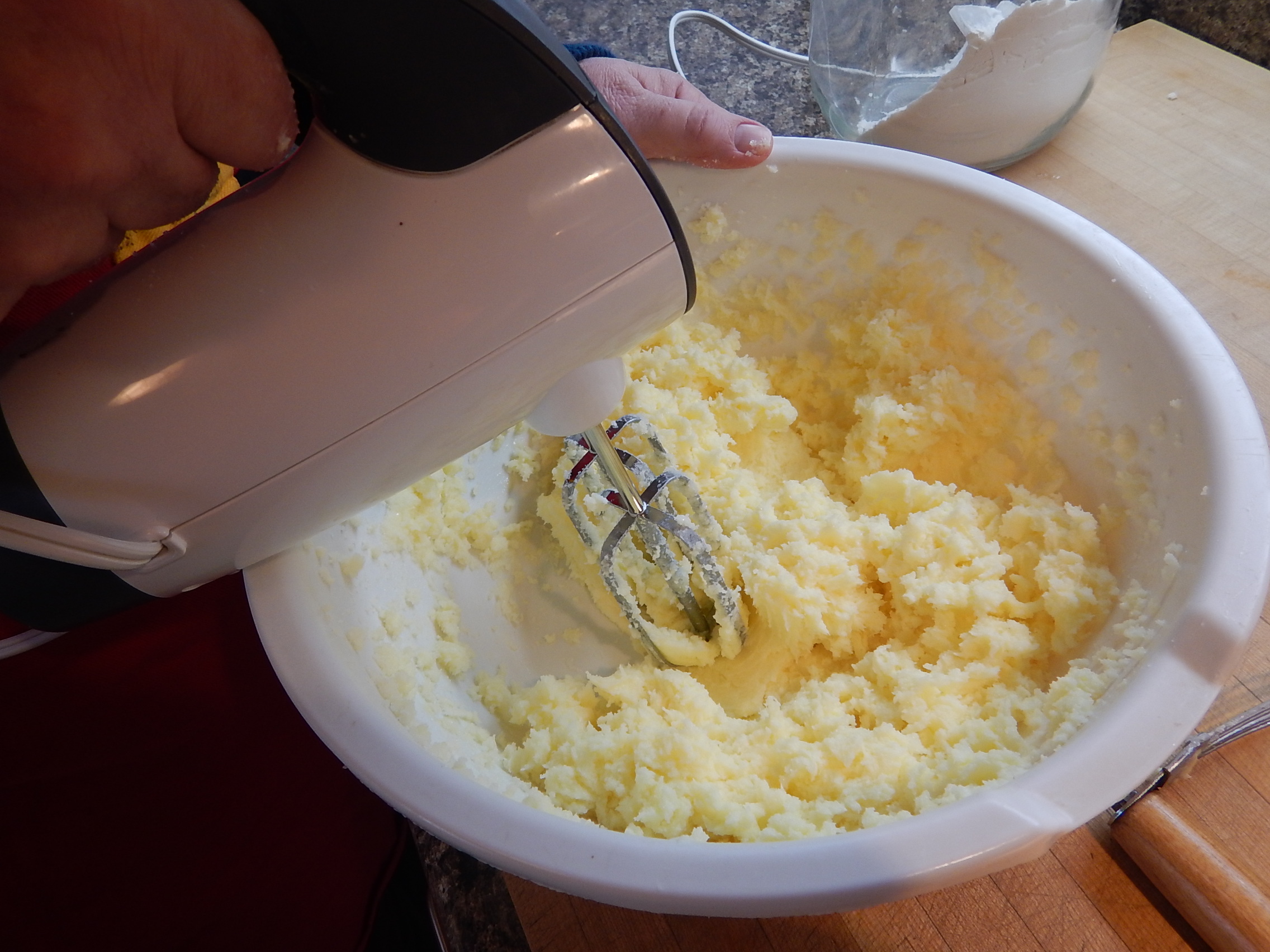
STEP TWO – Add the egg, beating until the mixture is light & fluffy.
More beating is better than less. When I think it’s enough, I do it some more just to be sure 🙂 Using the electric mixer is super easy, so I’m not exhausting my arm like I’d be using a spoon.
photo by SVSeekins
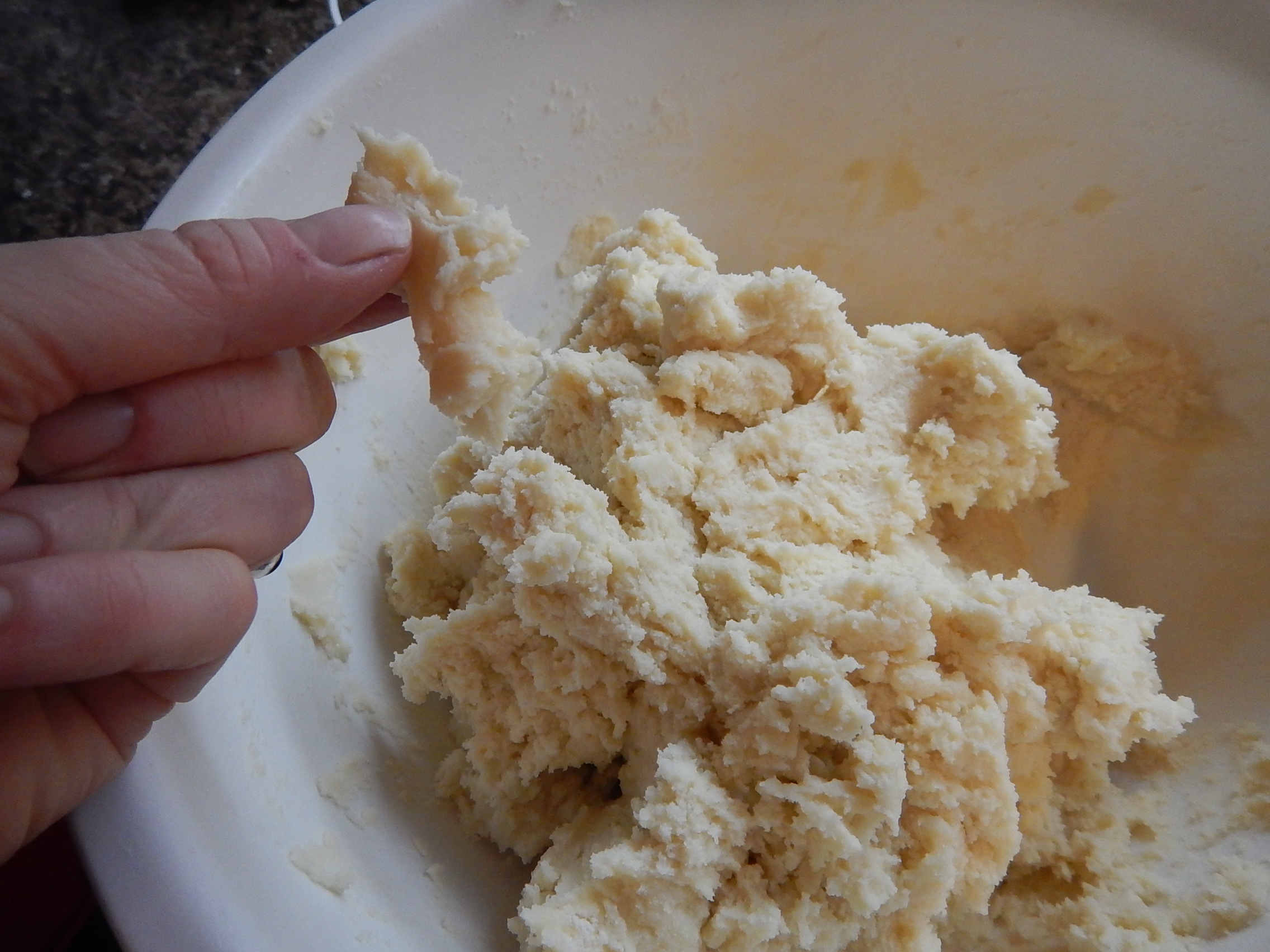
STEP THREE – Slowly blend in the flour.
Slowlybeing the trick to stop the flour from flying all over the room when the mixer paddles hit it. No need to over do it.
The dough should be firm & a bit crumbly. I usually feel like I’ve added too much flour, but this is the way it needs to be to go through the cookie press well.
Christmas Elf Barbara Hansen, photo by SVSeekins
STEP FOUR – Pre-heat the oven to 375 F.
(190 C)
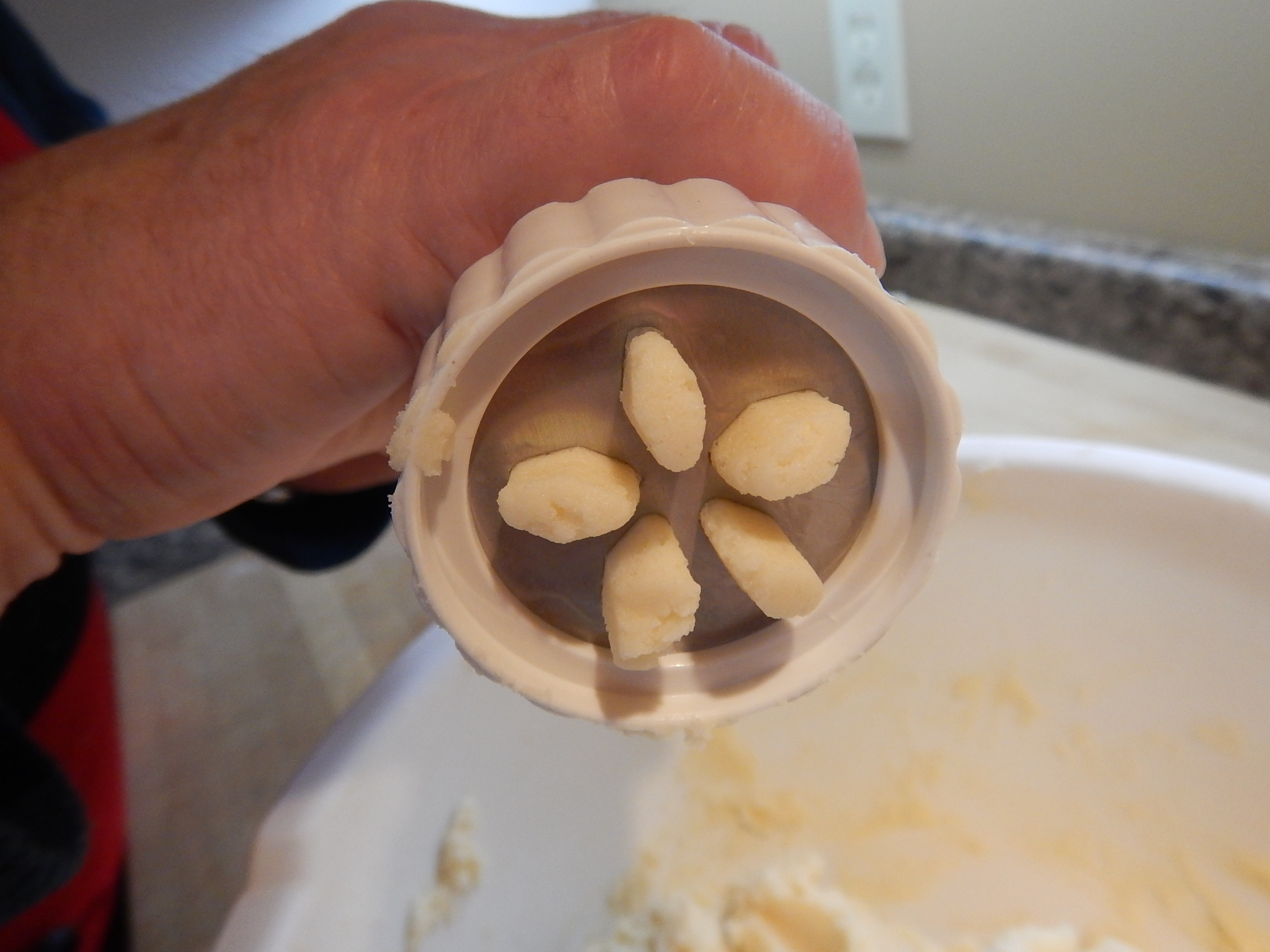
STEP FIVE – Fill the cookie press with dough.
Yup, I’m tempted to use fingers to stuff it all in faster, but a spoon is best for keeping the dough cool.
Pack in as much cookie dough as possible, pushing out air pockets.
photo by SVSeekins
Screw on the top handle & click it a couple of times until the dough oozes through the cookie-form disc. Click once or twice more to prove it flows smoothly. Break off the excess & return that to the bowl for later use.
STEP SIX – Press cookies onto a ungreased cookie sheet.
photo by SVSeekins
One click –
One cookie.
The cookies will spread out only a little bit during baking so they can be arranged fairly close to each other on the pan.
It’s the quick flick of the wrist when shifting the press that breaks the dough cleanly between cookies. If the dough is too warm, it’s not as easy. When it’s all working, it’s like magic. It makes all that prep work worth it 🙂
photo by SVSeekins
If it’s just not working & I’m getting really ticked off, I take a zen moment & eat a little cookie dough. An easier option is to roll a teaspoon of dough into a ball with my hands & place on the cookie sheet.
Not as fun, but it works. Less angst.
STEP SEVEN – Bake in a 375 F oven for 8-10 minutes.
photo by SVSeekins
Yeah, that doesn’t seem like much time, but it works. I watch through the window until there’s just a hint of brown along the edges. The cookies at the very front of this pan are over-done.
STEP EIGHT – Cool the cookies on the pan for a few minutes to let them stiffen. Then shift them to a cooling rack.
Enjoy some yourself while they’re still warm 🙂
photo by SVSeekins
* I copied the original recipe into my cookbook so long ago that I really don’t remember who or where it came from. I can’t take credit for the list of ingredients, but I’ve embellished the instructions through many failures & successes.
















 Garden Variety Life