Tag Archives: deer resistant

Belief In Magic

It was one morning in September 2006 when I realized fairies are real.  Dancing in the autumn chill beneath the birdbath was a flurry of naked ladies.

colchicum in bloom
photo by SVSeekins

I found them enchanting…
surely elves & pixies would pop up any minute.

Only a month had passed since we’d purchased our home.  I’d done nothing in the yard, besides delivering a few pots from our old home.  This magic just ‘happened‘…  unprompted.
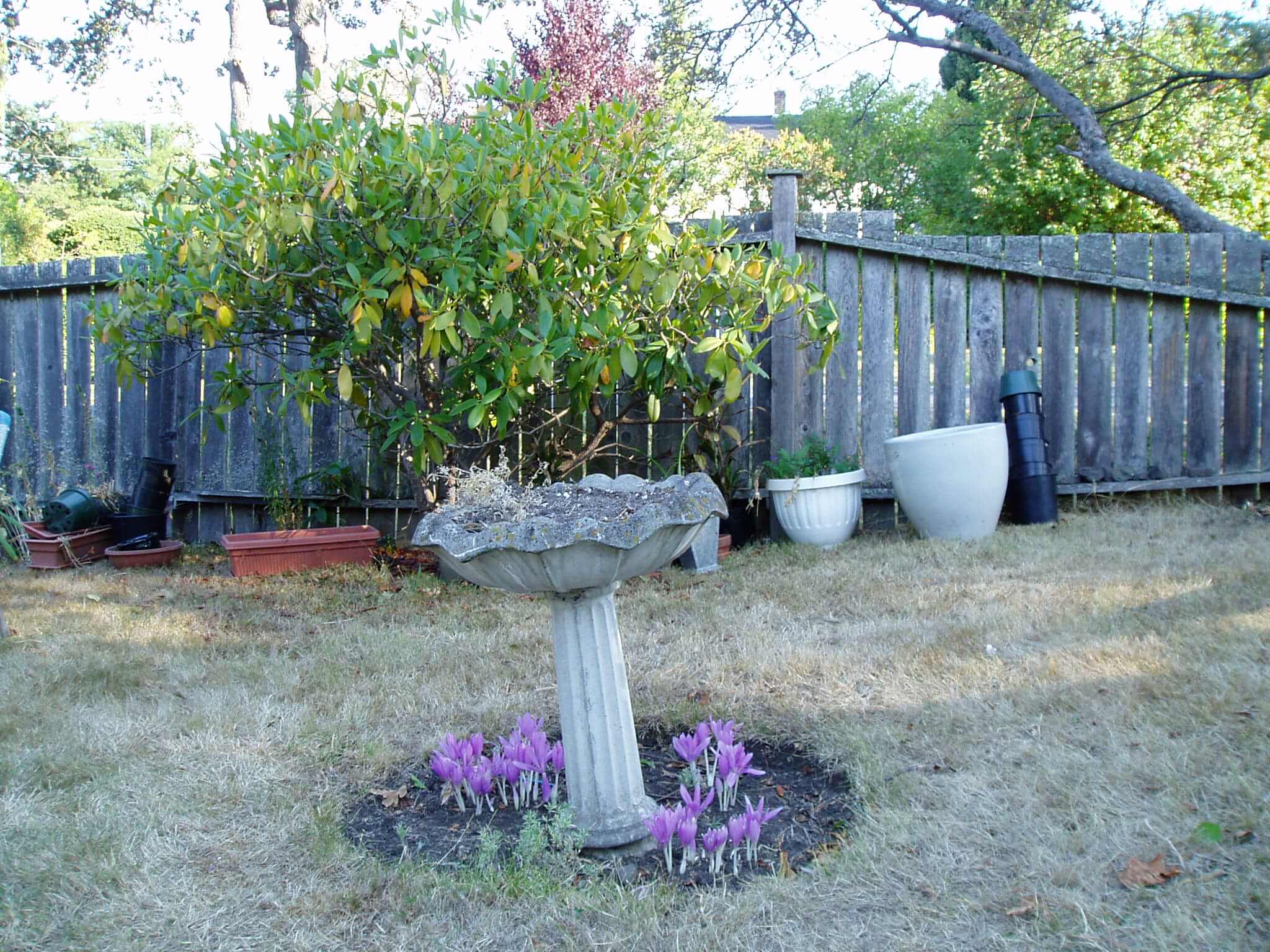
birdbath 2006 09
photo by SVSeekins

We were crazy-busy, making the house our own.  It would be a long while before much time could be spared for gardens…
yet I knew, then & there, this circle of fairy dancers had to be incorporated into our landscape plans… Somehow.

Given the birdbath & tiny flower bed was awkwardly adrift in a sea of lawn, I needed imagination.  It took me a while to figure out what to do with it.

birdbath bed 2008 01
photo by SVSeekins

Finally, we moved forward, creating a corner border. Rock edging started at the forsythia & gate (to the right / east)…
encompassed the birdbath,  & cherry tree at the end of the driveway (center-right)…
then followed the northern fence line to the rhododendron (far left).  (photo: Xmas 2007)
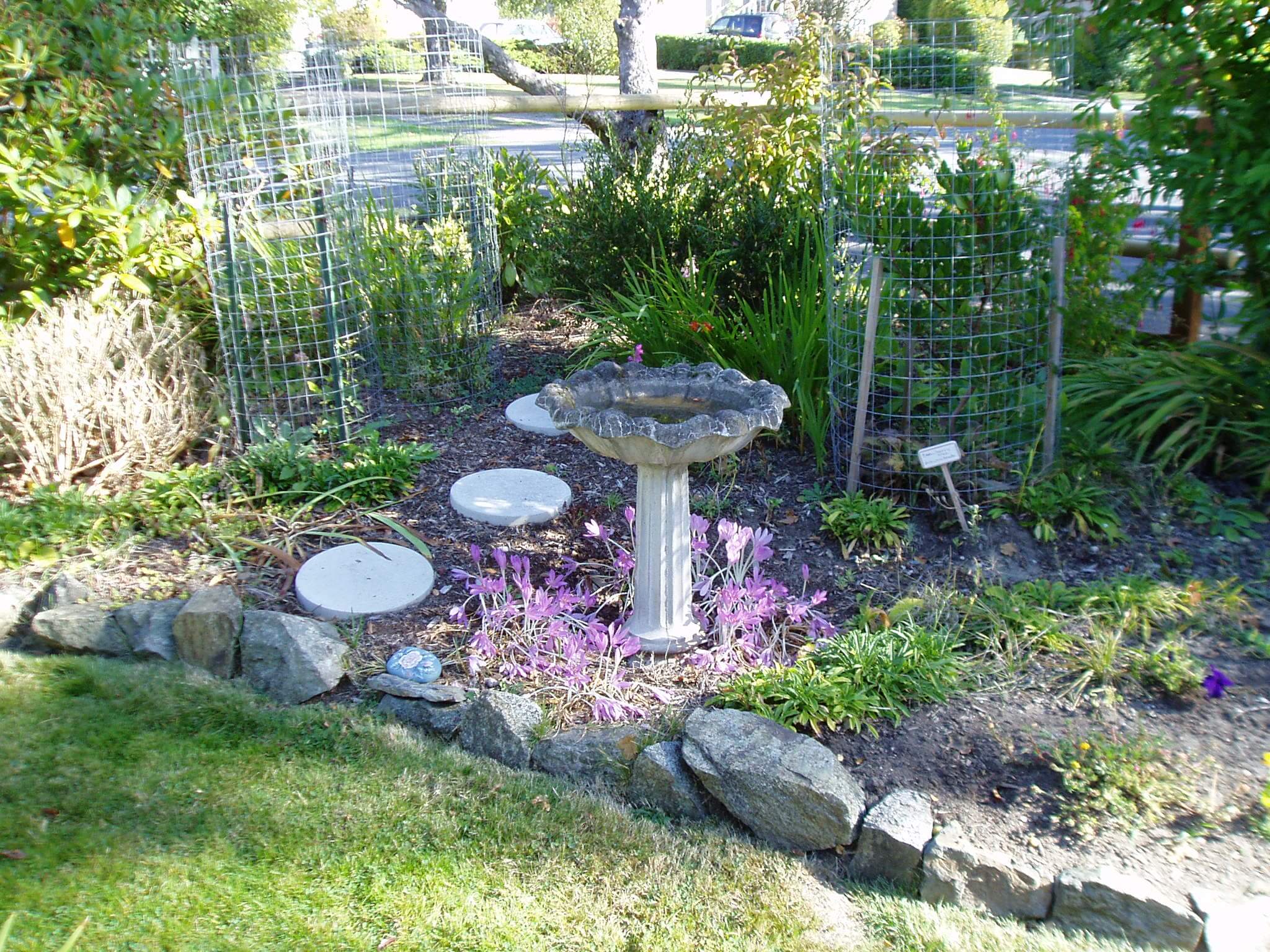
birdbath bed 2009 08
photo by SVSeekins

Early on, it felt like a giant, near-empty space that would take forever to turn into a real garden.  The new shrubs seemed tiny & lost. The local deer nibbled the Strawberry Tree (Arbutus unedo).  They nearly destroyed the Bottlebrush (Callistemon) with their antlers. Happily, the fairies came back every autumn to dance in the shivery sunshine.  The deer gave them peace. 🙂     (photo: August 2009)
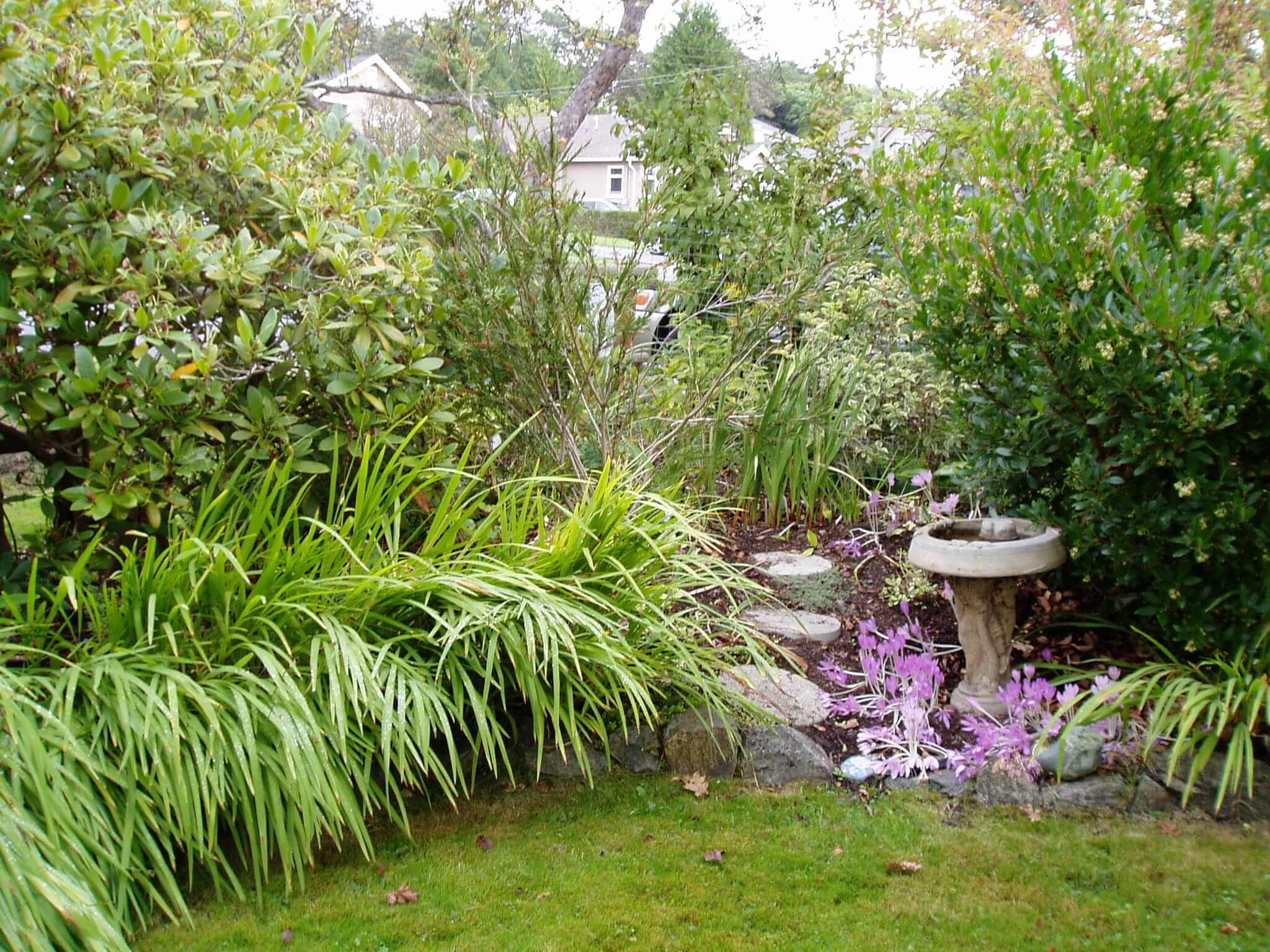
birdbath bed 2013 09
photo by SVSeekins

Five years in, it was starting to look like something more.   The Rhodo (far left) loved the company – growing almost as much as the newer shrubs.  Those shrubs were now large enough to stand up against the deer a little better, so I removed their cages.  The birds & fairies were enjoying the extra privacy as the garden grew up around the birdbath.   (photo: Sept. 2013)
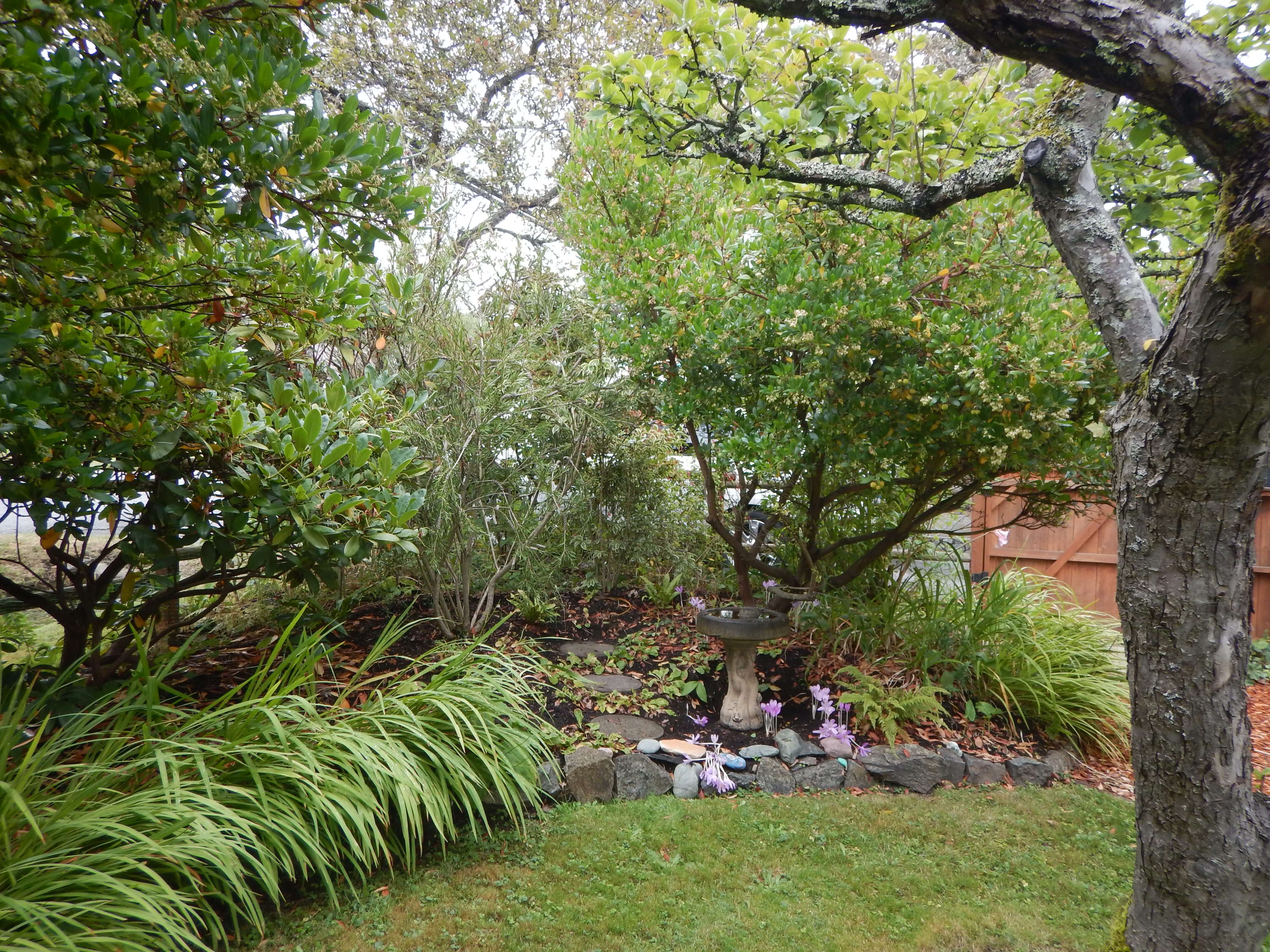
birdbath bed 2019 09
photo by SVSeekins

After a dozen years, the party continues.  The shrubs have matured into small trees.  The border has grown into a mini-woodland.  The birdbath almost disappears in the dappled understory! I reckon it’s even more magical than before. And each September, the fairies come to dance.     (photo: Sept. 2019)

-30-

Back From the Dead

We were away camping for most of August + early September. The garden had to survive through the dry heat all by itself.

Amaryllis belladonna , Madonna Lily, Jersey Lily, Amaryllis rosea, Brunsvigia rosea,, garden Victoria, Vancouver Island, BC, Pacific Northwest
photo by SVSeekins

Imagine my delight returning to a cloud of pink blooms hovering above the parched bed beside the front gate…

Granted, it’s only one stalk – – but what a cluster of flowers!  AND the deer hadn’t feasted on it as they had the surrounding daylily & crocosmia blooms–Bonus 🙂

To be honest, I’m shocked to see this resurrection.  For the past 10 years, I’ve resigned myself to being a Crinum killer.

Amaryllis belladonna , Madonna Lily, Jersey Lily, Amaryllis rosea, Brunsvigia rosea,, garden Victoria, Vancouver Island, BC, Pacific Northwest
photo by SVSeekins

The original bulb, a giant, came to me via a garden club plant sale.  It was labelled Crinum × powellii (aka Swamp Lily or Cape Lily).
Now I’m thinking it might be Amaryllis belladonna (aka Madonna Lily or Jersey Lily).

I planted it, thrilled at the first year’s blossom, then searched for signs of life the following year…
None…
Nothing the next year either…
After that, I just stopped searching.

Perhaps a hard winter froze the bulb…  (Crinum is zone 7: A.belladonna is zone 4.)
Perhaps too much drought shrivelled the bulb … (Crinum likes moist summers; A.belladonna prefers dry.)
Perhaps it had been crowded out by the crocosmia…  (Both Crinum & A. belladonna, like nerine lilies, prefer their necks exposed to sunshine… last winter I’d removed excess crocosmia)

Amaryllis belladonna , Madonna Lily, Jersey Lily, Amaryllis rosea, Brunsvigia rosea,, garden Victoria, Vancouver Island, BC, Pacific Northwest
photo by SVSeekins

There are so many ways to fail in the garden.  I resigned myself to losing another gem.

Now I’m thinking, it might have simply been a miscommunication in labelling.  Both Crinum & A. belladonna have similar tendencies (pink clusters of bloom… bloom time… toxicity… origins in South Africa… ),
But there are some significant differences, too (A.belladonna leaves die off before it blooms).

Either way, I’m grateful for whichever bulb I have.  It’s one tough cookie.  It patiently waited years until the conditions were just right!!

-30-

Here are some other pink autumn bloomers:


July Meadow

After our drain tile renovation destroyed our lawn, we laid sod.

clover, selfheal, purple deadnettle, meadow, self-heal, Prunella, garden Victoria BC Pacific Northwest
photo by SVSeekins

In the 10 years following, other plants joined the grassy monoculture.  Our classic lawn has become more of an urban meadow.

I still enjoy the tidy look of a freshly mown lawn… all smooth & green…  But I appreciate the wildflowers, too.

blacktail fawn deer garden Victoria, Vancouver Island, BC, Pacific Northwest
photo by SVSeekins

And I’m not alone.

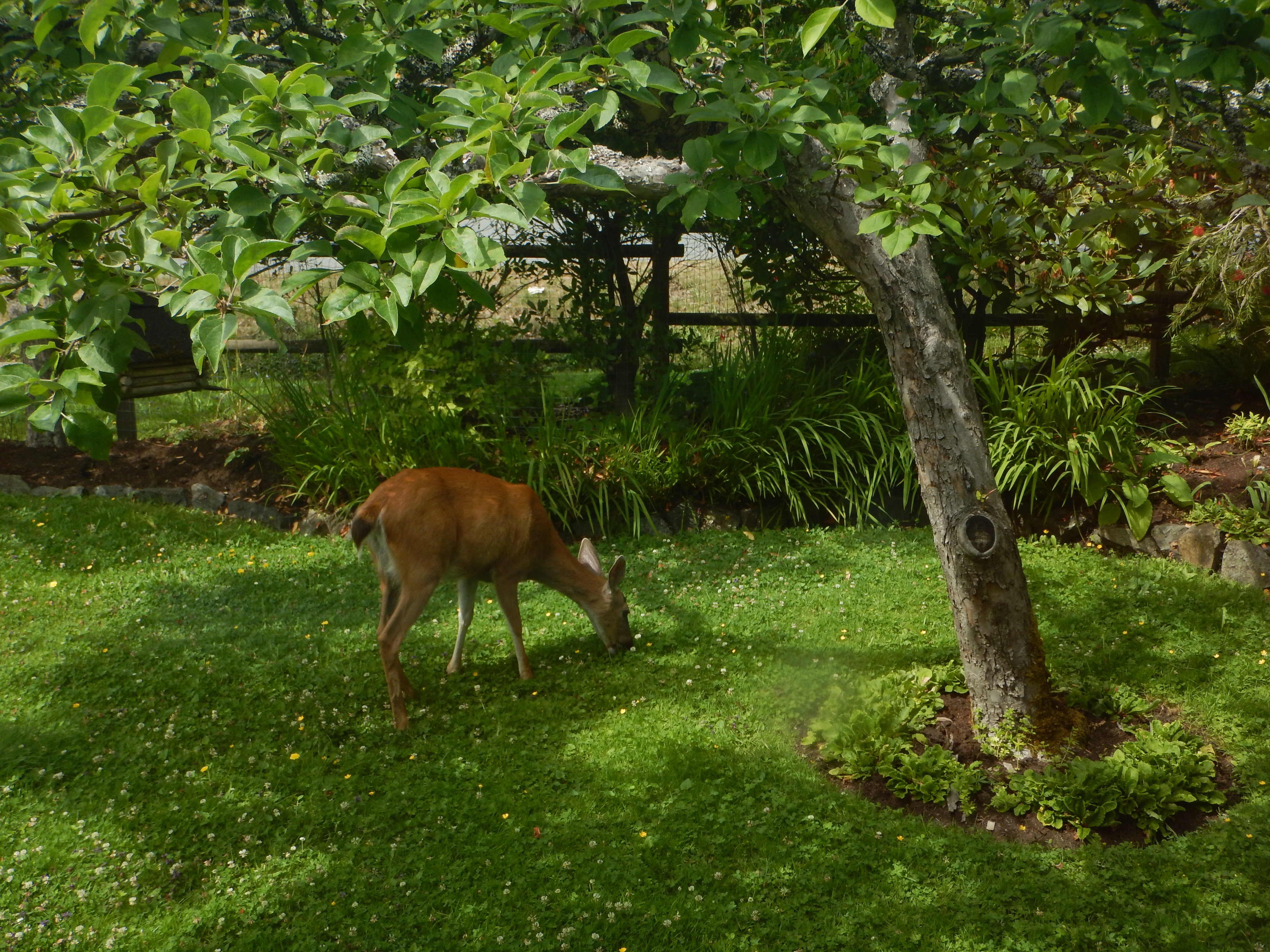
The local deer seem to be grazing the meadow more than harvesting the ornamental beds.
Hooray for that!
For the moment, I can enjoy watching the young family  – – rather than spend my time shooing them out of the garden.

wild clover, trefoil, Trifolium, garden Victoria BC Pacific Northwest
photo by SVSeekins

Wild clover naturalized early on.  It mostly blooms white, like the short Dutch clover, but often with a hint of pink.  Is it interbred with the larger red clover, which we grew fields of on the homestead?  So sweet.  Think clover honey…
(FYI – I’ve never been stung in our yard).

selfheal, purple deadnettle, self-heal, Prunella, garden Victoria BC Pacific Northwest
photo by SVSeekins

Self-heal, aka purple deadnettle, works wonderfully as a low-growing groundcover too. Like the clover, it stays green while grass browns in the summer dry. Prunella vulgaris blossoms attract more beneficial insects into our yard.  The seed feeds birds, too.

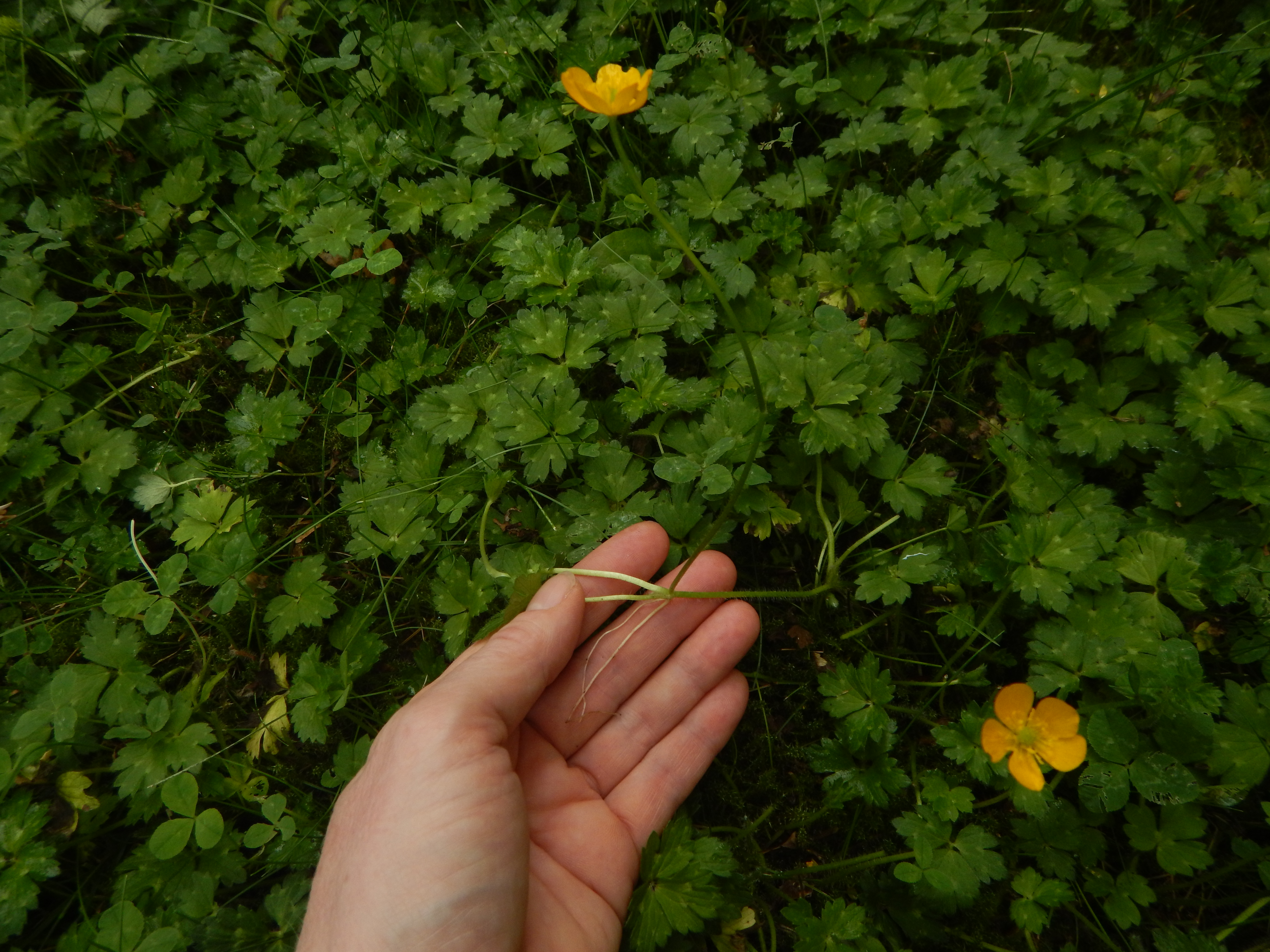
creeping buttercup, sitfast, restharrow, creeping crowfoot, Ranunculus repens, garden Victoria, Vancouver Island, BC, Pacific Northwest
photo by SVSeekins

The European Creeping Buttercup is well established under our apple tree & along the shady foundations of the house.  Ranunculus repens resides safely below the lawnmower blades. It colonizes via runners. New roots spring off a runner a few inches from the mother plant, creating a baby.  Then the same runner continues along for more adventures.  In our yard, it’s never crept toward the drier, sunnier areas.

creeping buttercup, sitfast, restharrow, creeping crowfoot, Ranunculus repens, garden Victoria, Vancouver Island, BC, Pacific Northwest
photo by SVSeekins

C thinks the buttercup is pretty.
But the deer avoid the whole plant.   They’ll graze carefully all around it.  To mammals, buttercup is toxic. (Blisters inside the mouth & throat are reason enough to avoid.)
That said, insects enjoy the flowers.
🙂

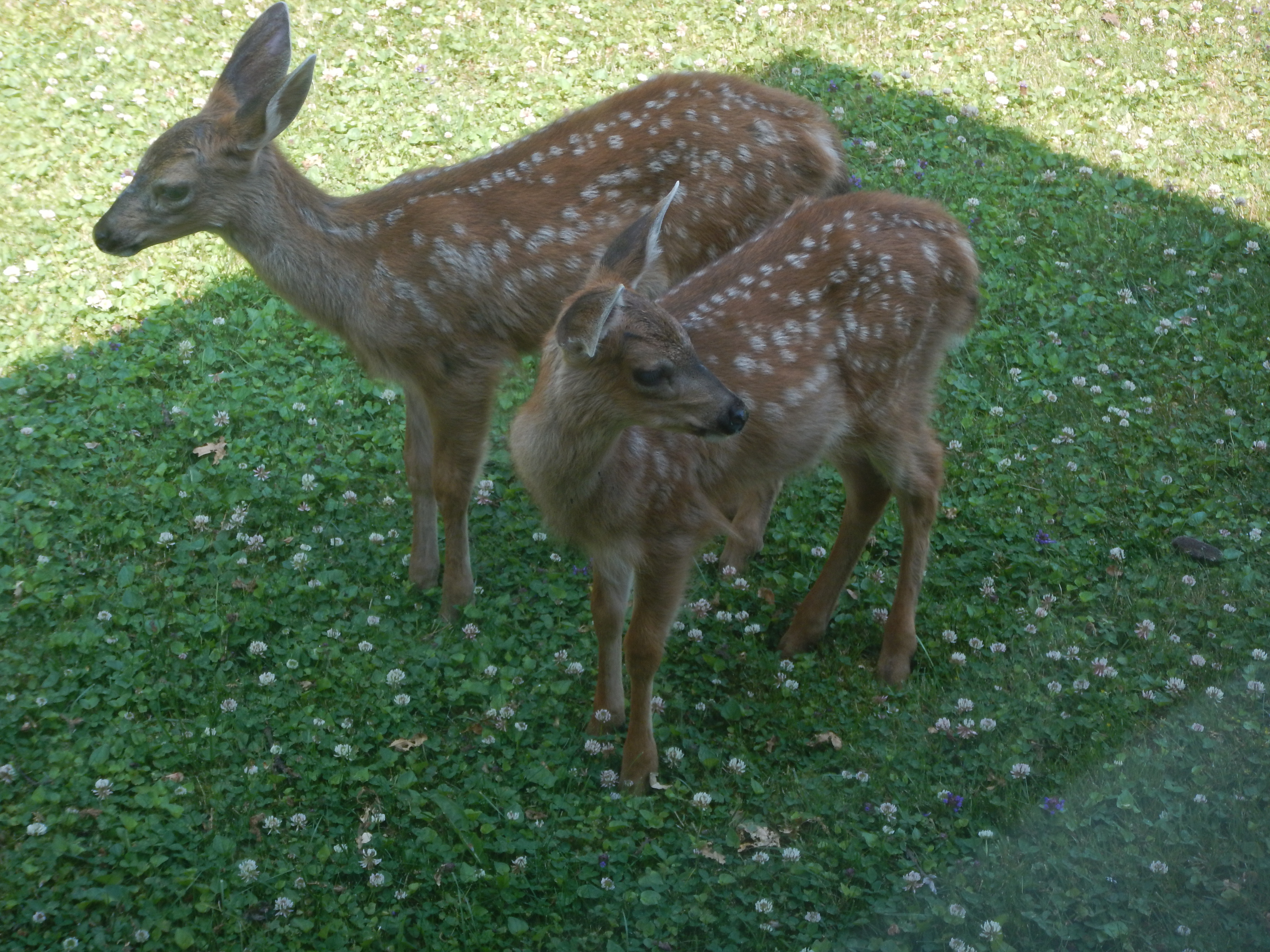
blacktail fawn twins deer, garden Victoria, Vancouver Island, BC, Pacific Northwest
photo by SVSeekins

I recently learned from Dr. L. A. Gilkeson that insects have declined at least 45% since the 1970s. (!! That’s 10 times faster than we’re losing mammals  !!) The decline is mostly due to habitat loss – and lawns don’t count as ‘habitat’ if they’re monocultures.

blacktail doe deer grazing on clover selfheal meadow, garden Victoria, Vancouver Island, BC, Pacific Northwest
photo by SVSeekins

In fact, untended weedy lots have more insects than a diverse ornamental garden.  Perhaps in relaxing our ideas about the golf green lawn, we’re helping sustain the insect population that’s left?  I’m confident our meadow hosts far more insects than the post-reno sod did.

blacktail fawn deer garden Victoria, Vancouver Island, BC, Pacific Northwest
photo by SVSeekins

This meadow is undoubtedly better for the birds & bees.  The deer like it more.  And it’s less maintenance for us.  With the deer helping out, C doesn’t need to mow or fertilize it as often.  We don’t water it as much.  Granted, the meadow wants to creep into the decorative borders just like a grass lawn does. So, I’m still edging the beds.  Oh well, one day, I’ll devise a solution for that.  In the meantime, I’m enjoying the flowers & all the wildlife.    🙂

-30-

Here are some other meadows: