Category Archives: months 01-03: winter

January thru March

Deer Proof

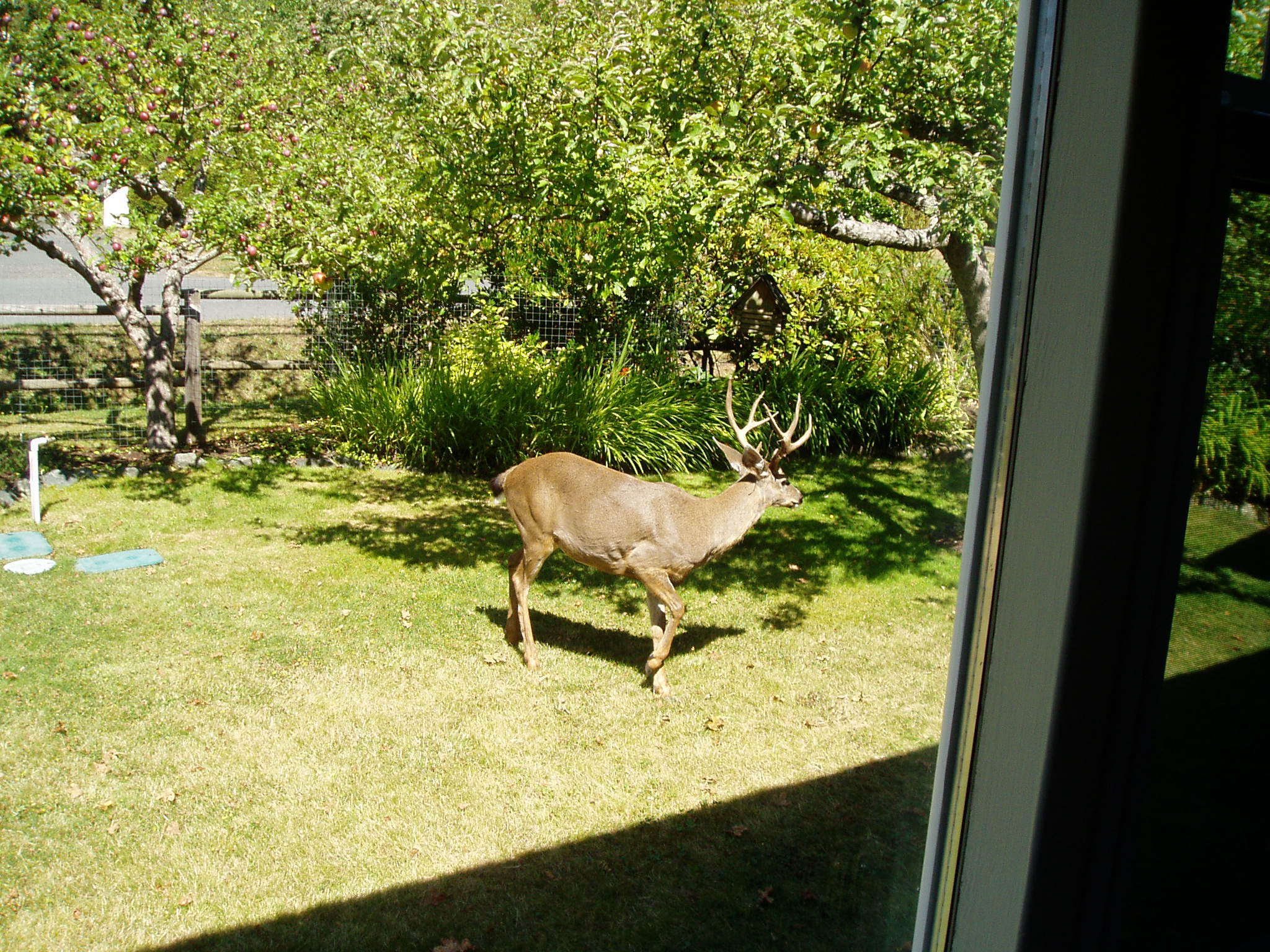
Deer under gravenstein apple tree
photo by SVSeekins

Now there’s Proof the deer really do hang out in our garden.
Photographic proof!!

AND it turns out he’s a 3 Point Buck!  Isn’t he a beauty?

This moment holds me still.. until I gather my wits & move carefully away from the window to get my camera.  I’ve been trying to get a decent shot of this fellow for over a month now but all the photos have turned out blurry….

urban black tail deer under sparten apple tree garden Victoria, Vancouver Island, BC, Pacific Northwest
photo by SVSeekins

Slowly moving back to the dining room window, I pretend to be calm & oblivious of the animal just a few yards away.  I don’t want to spook him.

He’s so close!

Surprisingly, growing up in the-back-of-beyond certainly never presented an experience of a deer so near – – unless it was already dead & being prepared for the oven.  But that’s just not the same.
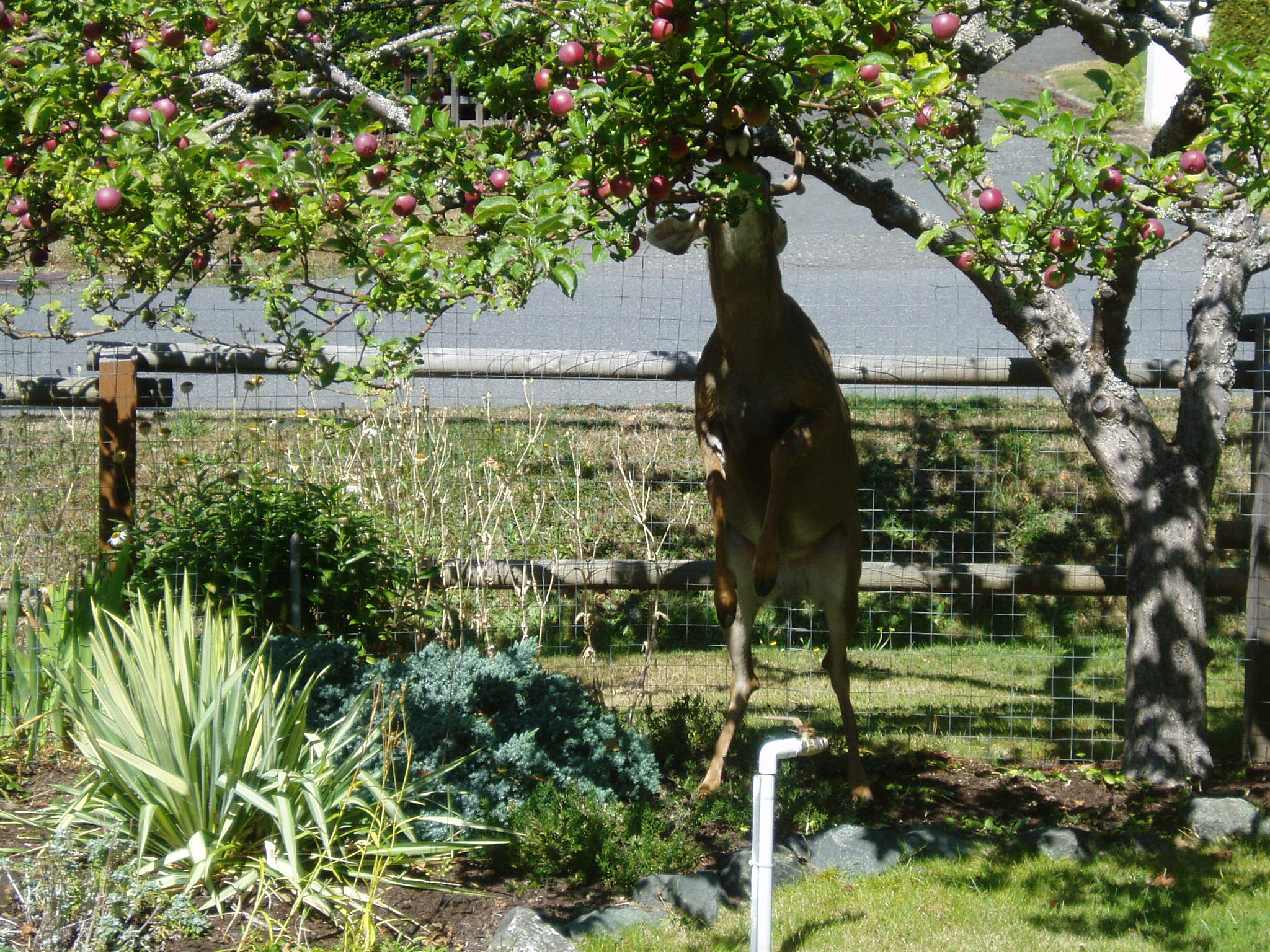
urban black tail deer climbing sparten apple tree Victoria, Vancouver Island, BC, Pacific Northwest garden
photo by SVSeekins

I’m a little in awe.  And quite glad to have the window between me & those antlers.  (There’s no fear when it comes to the doe & fawn.  I ‘shoo’ them out of the yard quite regularly.)

As I watch, it becomes clear he’s not just looking for a little shade.  He has a taste for apples.

Is nothing safe?
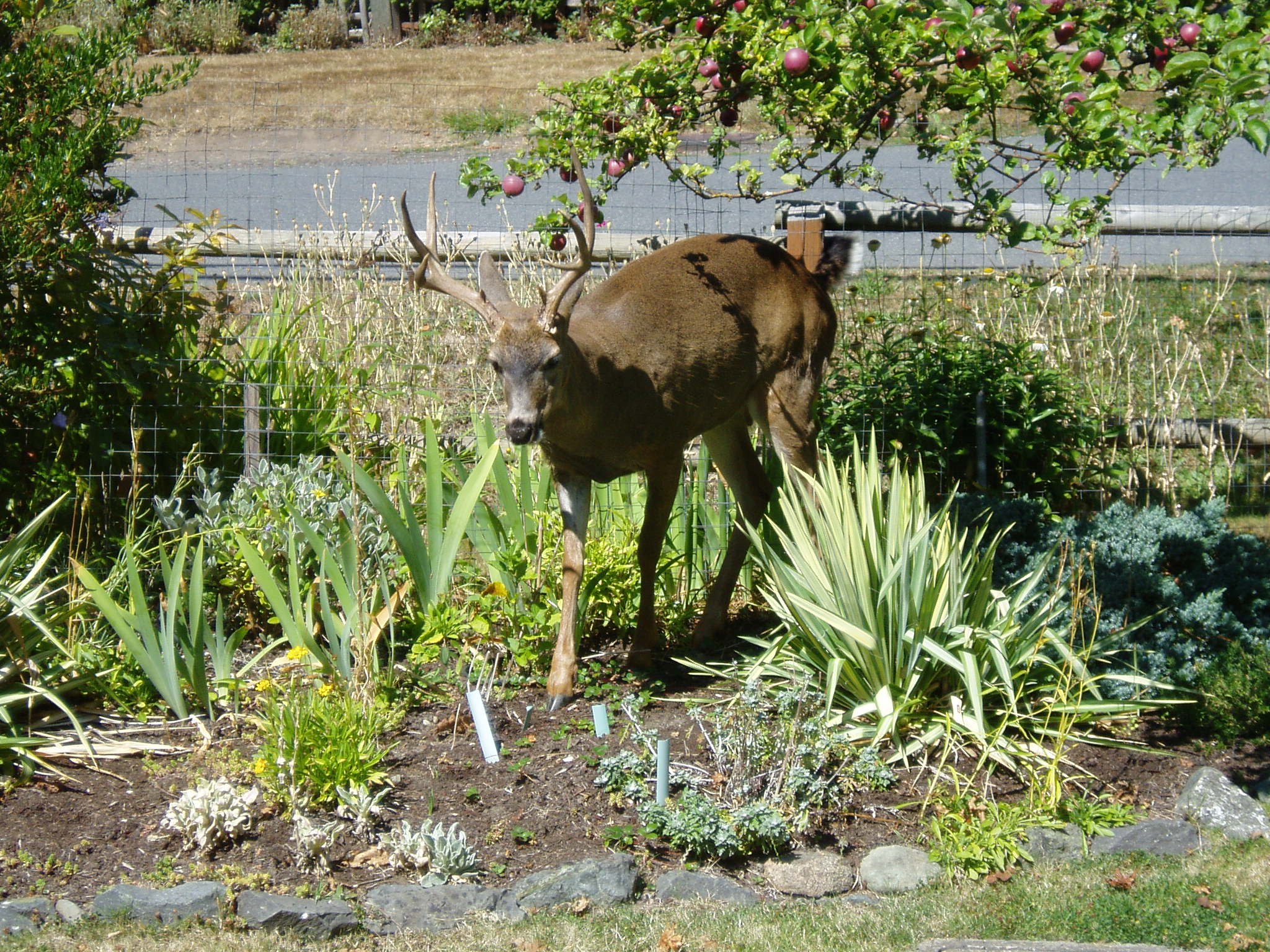
Deer in the full sun border
photo by SVSeekins

Well, there are plenty of apples this year, so sharing those is not really an issue.  I guess that if there is anything in the garden that I really want to be left alone, it’ll need to be caged in or sprayed with some of that stinky stuff.

But then, I dislike the smell of that stinky stuff and don’t like the idea of fencing the whole yard. (& I do enjoy seeing the deer)… So, that leaves the challenge of finding lovely plants that are deer proof… or at least some the deer don’t tend to munch on… that often.

I’m feeling kind of discouraged right now, in the heat of summer, because this year the buck seems to have a taste for the Rudbeckia, the Coreopsis, & Chinese lantern.  (Those were left alone last year)   But I have to keep in mind we’ve had better success with other plants.

At different times of the year, this patch of the garden can look pretty good.   Many early spring bulbs survive just fine:
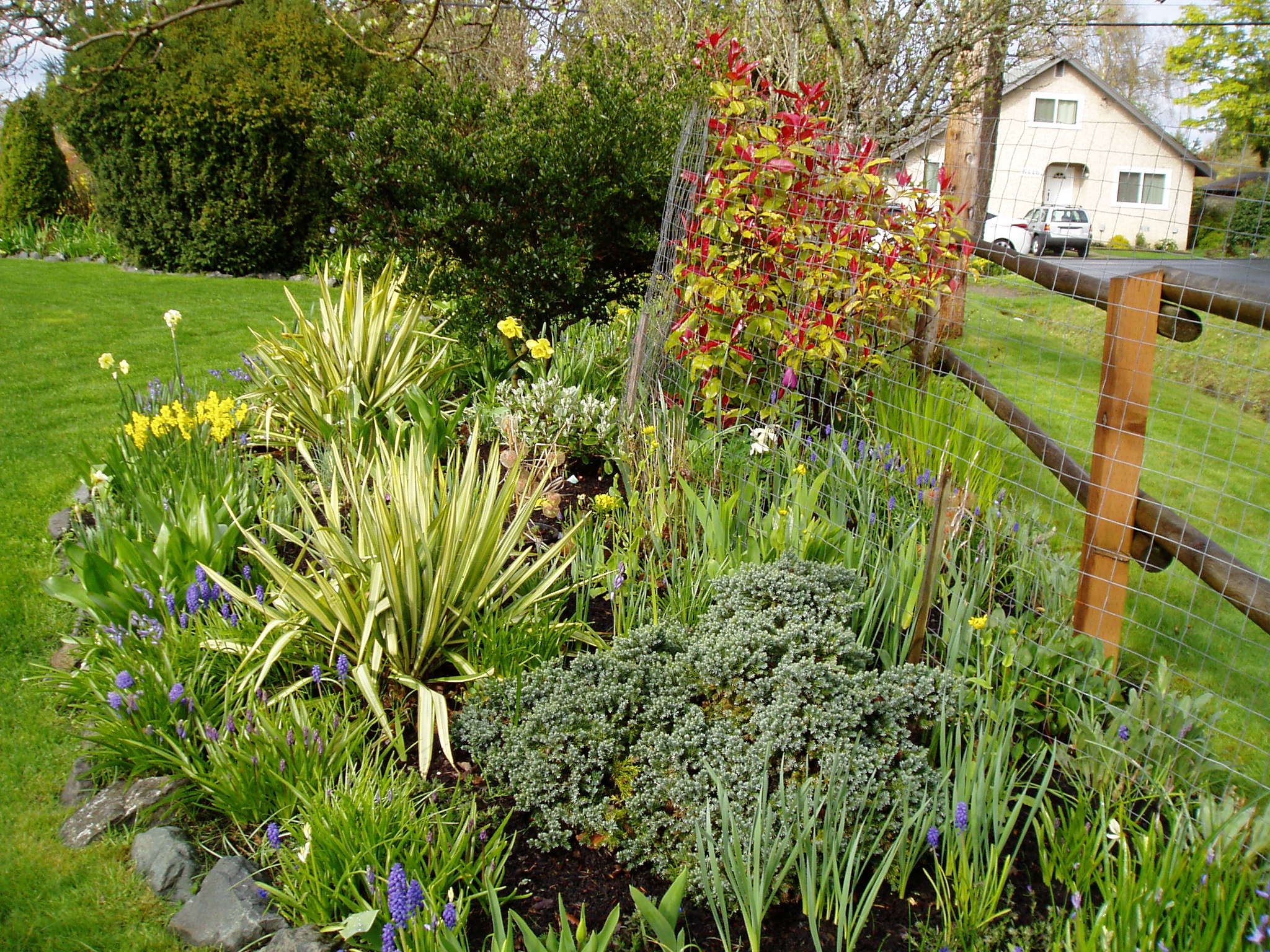
full sun garden in early april
photo by SVSeekins

By May there are some other successes:
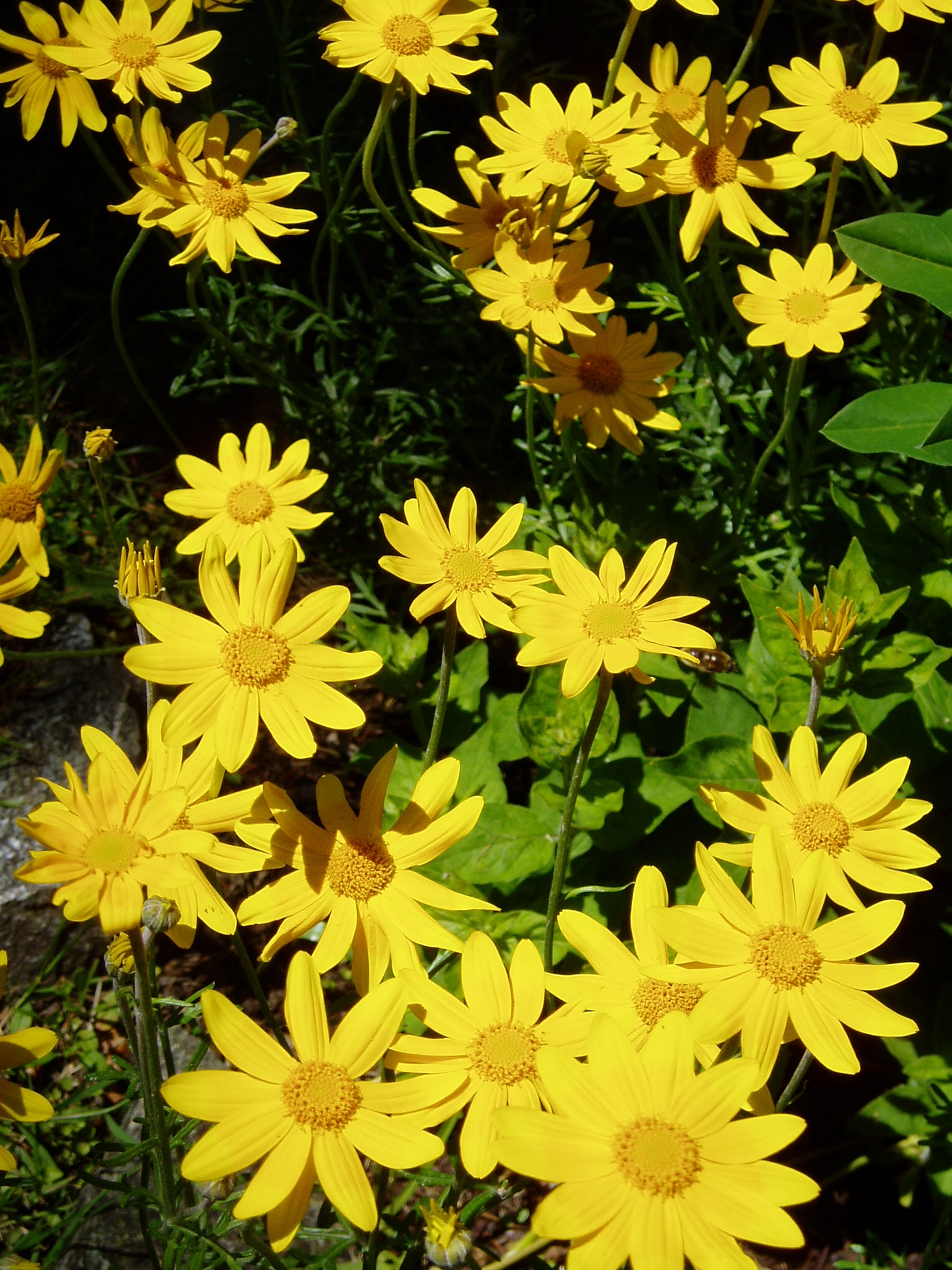
Eriophyllum lanatum, Woolly Eriophyllum, Wooly Sunflower, Oregon Sunshine, woody eriophyllum, wooly daisy, sunshine flower, garden Victoria, Vancouver Island, BC, Pacific Northwest
photo by SVSeekins
  • foxglove – digitalis
  • snapdragon
  • leopard’s bane – an early yellow bloom very reminiscent of a daisy  – – but related to an aster
  • Senecio greyii – also called the daisy bush – – or is it maybe really a yellow aster?
  • wooly sunflower – Eriophyllum – another aster type flower… do you reckon there’s a theme here?   hmmm…     (photo on right)

Check out this photo below from early June:
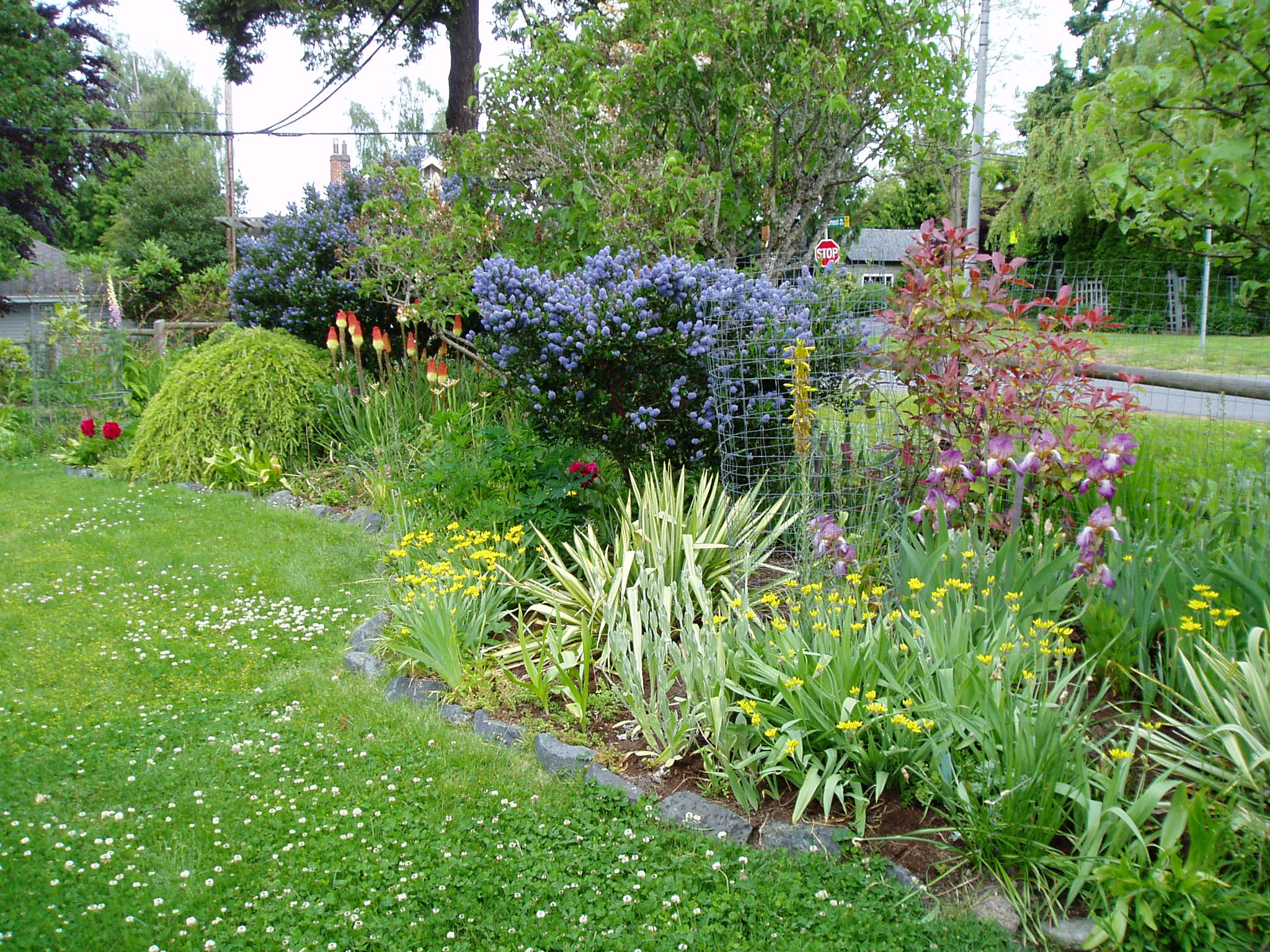
full sun garden in early June
photo by SVSeekins
  • Ceanothus (California lilac) – the two blue blooming shrubs (center & top left)
  • iris – blooming purple with white highlights (right)
  • peony – blooming red (far left)
  • red hot poker – Kniphofia, blooming yellow & orange between the 2 Ceanothus
  • Allium moly lutea – blooming yellow along the front of the bed (the last of the spring bulbs)
goldenrod & shasta daisy
photo by SVSeekins

Later in the summer, there are other gems that I can be fairly confident that the deer will turn their noses up on:

Even into the fall & winter – – when the deer are especially hungry, there are some successful survivors in the garden:

CU Colchicum grouping 1, garden Victoria, Vancouver Island, BC, Pacific Northwestolchicum - fall crocus.
photo by SVSeekins

No doubt there are other ‘deer resistant’ plants in our garden that haven’t been mentioned in this list. The more important thing to realize is that ‘resistant’ is as good as it gets.  Those critters are unpredictable when hungry.  Fawns are curious & just don’t know any better.   ‘Deer Proof’ does not exist.

Deer crossing lawn
photo by SVSeekins


-30-

P.S. The deer saga continues:

The Promise of Apples in 5 Steps

This year C wants a good crop of apples, so we’re trying to do everything right.

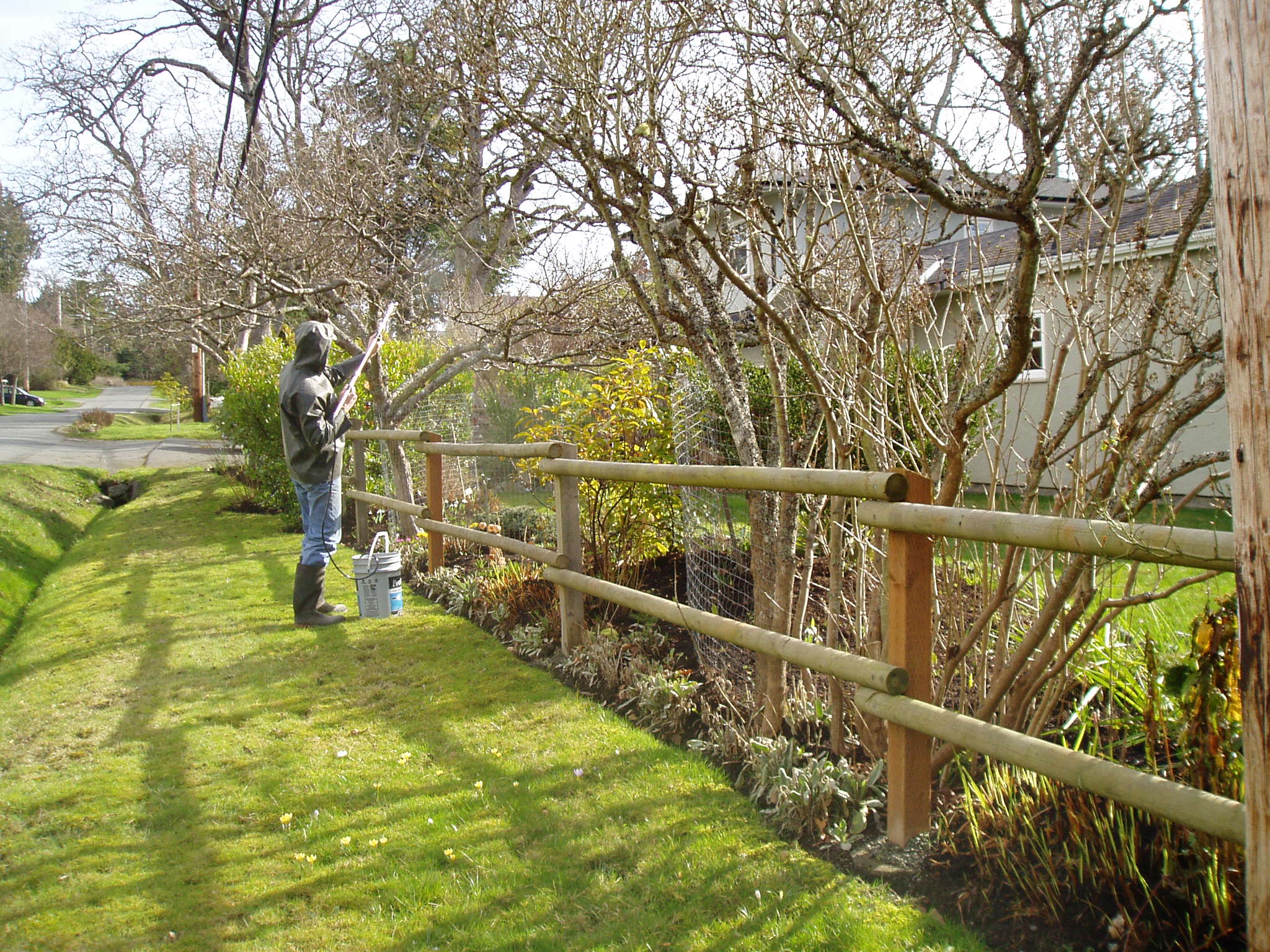
spraying the Sparten apple tree in February
photo by SVSeekins

STEP 1.  – SPRAY
In February C mists the 2 apple trees with dormant spray in hopes of warding off the regular infestation of those tiny green worms.  You know the ones: they float down from the Garry Oak & go crazy on the tasty apple leaves, before they burrow into the little apples.

It’s not easy to find a dry day in our West Coast winter for getting that job done.  It’s even tougher to follow with a few dry days that allow the sulphur/oil to do its magic before the rains rinse it off .

STEP 2  – PARTNERS
The next challenge is pollination in spring.   If it’s too windy, the blooms blow away.  If it’s too rainy, the bees can’t get to the flowers to pollinate them…  There’s not much we can do except cross our fingers for sunshine again.

Sparten & Gravenstein bloom overlapping is rare
photo by SVSeekins

And there’s also that concern over different apple varieties blooming at different times.

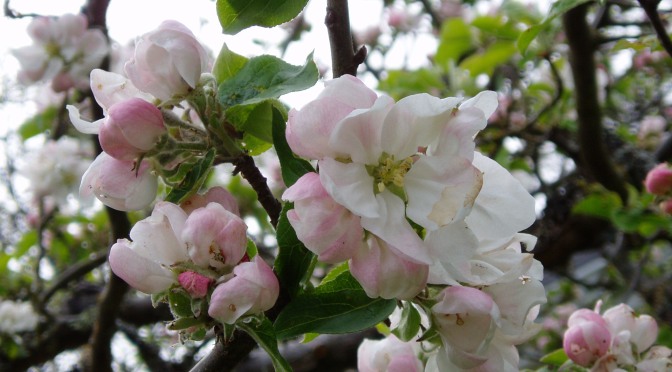
A Gravenstein blossom won’t turn into an apple unless it receives pollen from some other tree.  Strange, eh?  And Gravensteins are early bloomers – – hardly anything else is blooming then, so we rarely get much of a crop.

This year the weather was odd enough that the Gravenstein bloom was later & actually overlapped with the McIntosh bloom for a couple of days.  Woo Hoo!

after the Gravenstein leaf feast
photo by SVSeekins

STEP 3  – PROTECT
By June the leaves fill in.  I was disappointed to see signs they’d been feasted upon.

tent caterpillars in a Russian Laurel
photo by SVSeekins

Sometimes we find tent caterpillars up in the branches.  As a kid I thought fuzzy caterpillars were cute.  Once I saw a whole mass of them coming out of their tent I was grossed out.

By this stage the fruit is starting to form, so we’re not willing to do any additional spraying.  I prune the tent out of the tree, and seal the escape artists into a ziploc bag.  How much energy can a tree put into apple production when its main energy collection system is under such attack?  Bummer.

gravenstein apple in spring - mcu
photo by SVSeekins

STEP 4 – THIN
When I first heard of thinning apples in spring, it sounded crazy! I’m always so excited to see all the new apples. Doesn’t it make sense to just let them ALL grow?  But, especially after a  successful pollination, even nature will cull a heavy load.  Now I think about how many apples the tree can support…
and do we want many little apples?…
or a few really big apples?

This year I can already spot a few Gravenstein apples hiding in the foliage.  The McIntosh are easier to spot.  Before the summer solstice arrived, C cut out about 1/3 of the crop from the McIntosh.  There’s so many up there, he figures he might just take 1/2 the crop to give the rest a chance to mature.

A full crop
photo by SVSeekins

A couple of years ago I had culled 10 gallons of golf-ball-sized apples from the McIntosh.  It wasn’t enough.  By August we worried the limbs might break from the increasing weight.  We used stakes to help support the branches!

STEP 5 – ENJOY
Now that summer is here, the chores get simpler:
Wait… and water.

If the summer continues with the lovely heat & sunshine of last weekend, I’m planning to put a lounge chair under the tree & enjoy the mist while the sprinklers do the work.  🙂

-30-
© SVSeekins and Garden Variety Life, 2013

Meadow Blooms 2 – Chionodoxa

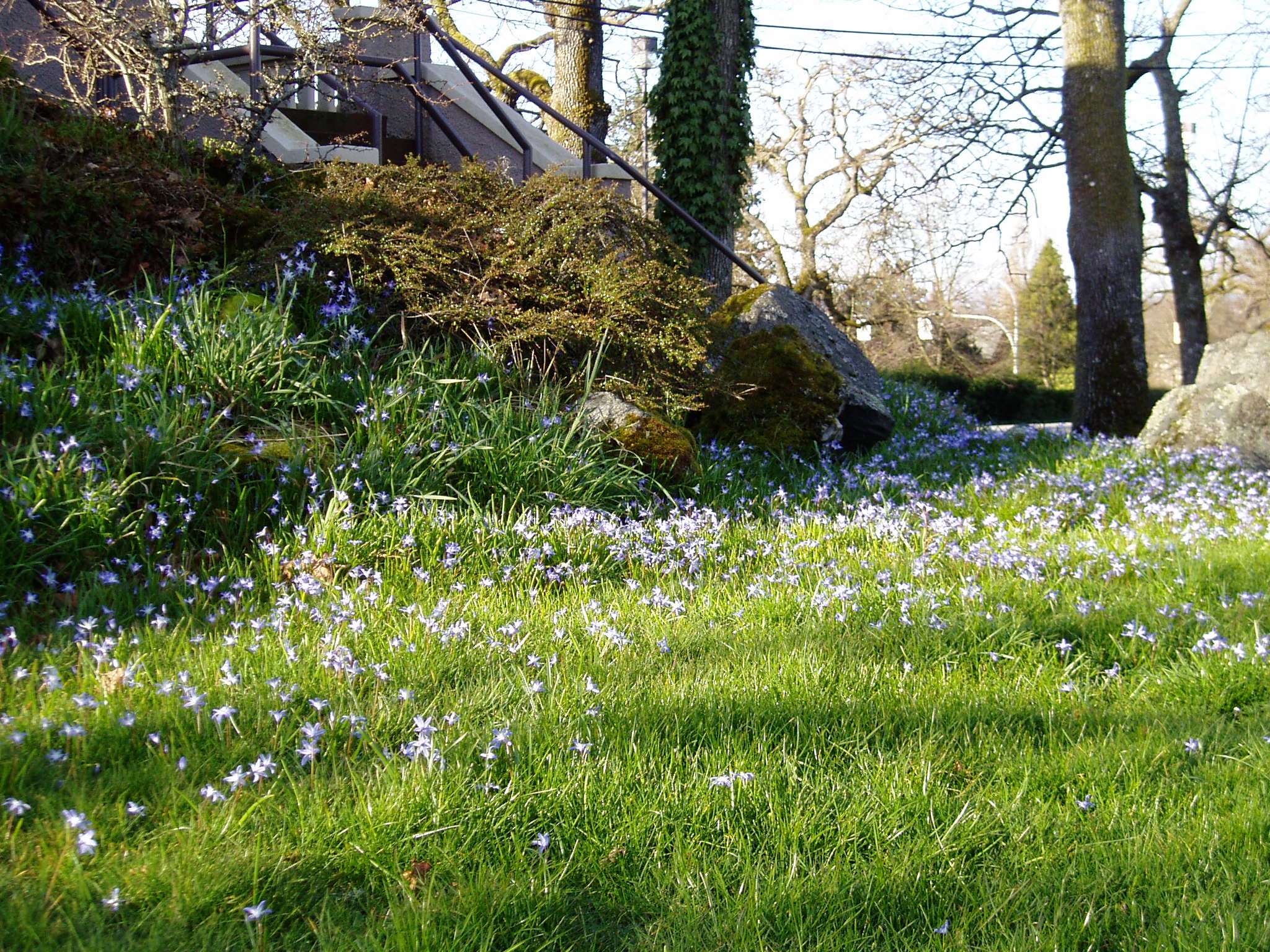
Chionodoxa - Glory of Snow near Dunlop House
photo by SVSeekins

A couple of years ago, in March, I started noticing patches of tiny blue flowers along the roads of older neighbourhoods. Flowers flourished in areas that hadn’t been manicured for a very long time.

I soon realized these blooming meadows are the naturalized dreams of gardeners past. I’m charmed by that romance.

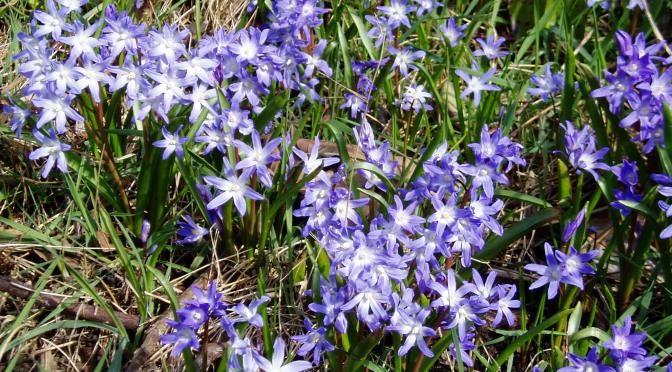
These hardy bloomers are Glory of Snow, or, if you like unpronounceable names: Chionodoxa. Try to say that easily the first time around! 🙂

Glory of Snow originated in Turkey & Greece – along the Mediterranean.  I’ve heard southern Vancouver Island compared to a Mediterranean rain forest, so it makes sense these plants survive well here.  What surprises me more is that they’re hardy to zone 4!  They can withstand a whole lot more cold. Do these grow in your neck of the woods??

Chionodoxa - Glory of Snow in rock crevice
photo by SVSeekins

Aside from naturalizing well, these plants are also valuable to me because they’re:

  • winter blooming
  • drought tolerant 
  • low maintenance

Once planted, just leave them to their own devices.  How great is that?  I’ve even seen them surviving in shallow crevices of rocky outcroppings.

Chionodoxa - Glory of Snow meadow behind Dunlop House
photo by SVSeekins

They seem perfectly happy in lawns, too, although I’ll bet they do better if the grass isn’t cut until late April when they’re done for the season.  That would mean it’s more of a meadow than a lawn.  C wouldn’t go for that.  He likes lush but trim.  That’s why I’ve added Glory of Snow as under-story plantings in our shrub border instead.

The best patch I’ve ever encountered is around Dunlop House Restaurant, a heritage building on the grounds of Camosun College, and their Hospitality Management Program facility.  C’s mum took us there for supper the other night.  The meal was lovely, and the meadow: spectacular!

-30-
© SVSeekins and Garden Variety Life, 2013

P.S. Here are some other meadow faves: